
What causes change order disputes in construction?

Most change order disputes trace back to six causes, and to the GC’s position between an owner who hasn’t approved the change and subs who have already done the work.

Eight months into a job, the change order log is rarely clean. Some requests are approved. Some are priced and waiting on the owner. Some cover work a subcontractor finished weeks ago on the superintendent's word, with a signed T&M ticket as the only record.
Most of those items get settled. The ones that turn into disputes usually trace back to six causes, and to the GC's position in the middle: an owner who has not approved the change on one side, and subcontractors who have already done the work on the other.
This article covers those six causes and who ends up carrying each one, the signature that can close a claim before it is filed, and why prevention tends to break down halfway through a project.
What is a change order dispute?
A change order dispute is a disagreement over a change to the contract: whether the work is a change at all or part of the base scope, what it is worth, how much time it adds, or whether the contractor followed the procedure the contract sets out. On AIA projects, the change itself is recorded on a G701 form signed by the owner, the contractor and the architect.
Six causes of change order disputes, and who carries each one
1. Scope wording the owner and the sub read differently
The prime contract says "complete and operational system." The mechanical sub's quote excludes controls wiring, and its subcontract scope copied the spec section without the exclusion list. When the controls work comes up, the owner says it was always in the base contract and the sub says it was never in its price.
The GC carries the gap between the two readings. It cannot recover from the owner what the owner considers included, and it cannot make the sub do work the sub never priced without paying for it.
Gaps between trade packages work the same way, as we describe in how subcontract scope gaps appear in the documents.
2. Directions given on site and never formalized
The owner's representative walks the site with the superintendent and asks for a change. The super tells the drywall foreman to proceed and signs the T&M ticket at the end of the day. The change order request goes out three weeks later, and the owner answers that its representative had no authority to direct changes, or that the work was in scope.
The sub holds a ticket signed by the GC's superintendent and expects to be paid either way. Most commercial contracts require a written change order or construction change directive before changed work starts, so the GC often ends up paying the sub before it has any agreement with the owner.
3. Pricing and markup rules nobody remembers in month eight
Both sides can agree that a change happened and still fight over the number. The general conditions may cap overhead and profit on subcontracted work, limit markup to one tier of subcontractors, or exclude certain costs from change pricing altogether. The PM pricing a request in month eight is usually working from memory, not from the general conditions.
Owners read change orders closely. When the City of Chicago's Inspector General reviewed 228 change orders on public building projects in 2018, it found at least one problem in 99 of them, or 43.4%, including proposals without enough detail to support the price and markups above the caps the owner had set.
Every request that comes back for more backup is cash the GC has already spent and not yet recovered.
4. Notice windows that leave no time to pass a claim up
Many contracts require written notice of a change or a claim within a set number of days after the event. The subcontract may give the sub the same window the prime contract gives the GC. If the sub sends its notice on the last day, the GC has no time left to send its own notice to the owner.
The GC then owes a claim it may no longer be able to pass up. Our guide to construction notice software covers how teams keep track of these windows across a project.
5. Site conditions nobody could see at bid time
Rock where the geotechnical report showed clay, an abandoned duct bank under the slab, asbestos behind a wall slated for demolition. Nobody argues the condition exists. The argument is about who pays, and how fast.
The excavation sub priced to the geotechnical report and starts billing standby the day the rock shows up. The owner may take weeks to decide whether the differing site conditions clause applies. In between, the GC carries the sub's standby costs and the schedule.
6. Errors and omissions nobody priced
The spec calls for 5,000 psi concrete and the structural drawings say 4,000. The door hardware section lists access control at every stairwell door, and the electrical drawings show no rough-in. Each one becomes extra work, and the extra work becomes a change order request.
The owner tends to answer that a careful bidder should have caught the discrepancy, especially when the bid documents asked bidders to report conflicts before bid day. The cheapest version of this dispute is the question asked during bidding.
The signature that can close a claim before it is filed
Many change order forms include a release: by signing, the contractor accepts the adjusted price and time as full compensation for the change. Some releases go further and cover delay, disruption, and the cumulative impact of many changes on the rest of the work.
In Bell BCI Co. v. United States, decided in 2009, the trial court had awarded the contractor delay damages and profit on its delay and cumulative impact claims. The Federal Circuit vacated those awards. The contractor had signed modifications whose release language, the court found, covered those claims.
On a long project, the release paragraph in each change order can decide what the GC is still able to claim when the job is over.
The practical habit is simple to state and hard to keep under pressure: read the release paragraph on every change order before signing, check that it covers only the change in question, and reserve rights in writing for time and cumulative impact when the full effect of a change is not yet known. How a given release applies depends on the contract wording and the law that governs it.
Where these causes sit in the documents
Most of these causes can be found in the documents before any work starts. The changes clause says who can direct a change and in what form. The notice clauses set the windows for changes, claims and time extensions. The pricing terms set the allowed methods and markups.
The order of precedence says which document governs when a spec and a drawing disagree, and the change order form carries the release wording.
These clauses should be read together, and against every subcontract. A notice window in a subcontract only works if it leaves the GC time to meet its own window in the prime contract. A scope that flows down by reference only works if the sub's exclusions do not reopen what the prime contract closed.
Why prevention breaks down halfway through a project
Every GC knows the basic rules: get directions in writing, know the notice windows, price changes by the contract. The rules hold up in the first month. By month eight, the contract summary from the turnover meeting sits in a binder, the superintendent handles dozens of field requests a week, and subcontracts awarded months apart carry different windows and exclusions.
What helps is moving each check to the moment someone actually needs it:
- Before signing the prime contract, list the change, notice, markup and release rules, and flag any that are hard to meet.
- When awarding each subcontract, compare its notice windows and exclusions with the prime contract.
- On site, turn every owner direction into a written record the same day, naming who gave it, what was asked and when.
- When pricing a change, work from the markup and cost rules in the general conditions, with the page in hand.
- Before signing each change order, read the release paragraph and reserve rights where the impact is not yet known.
Where Telamont fits
Telamont finds issues in your drawings, specs and contracts, so you fix problems on paper, not on site. Before signing, its risk detection flags change clauses that give the other party control, notice periods too short to comply with, obligations passed down to subs without their protections, open-ended completeness clauses, and conflicts between specs and drawings.
Each risk opens the document at the page it comes from.
During the project, the team can ask the agent what markup the contract allows on subcontracted work and get the answer with the page it comes from. Boards keep change order pricing and notice requirements on one shared page.
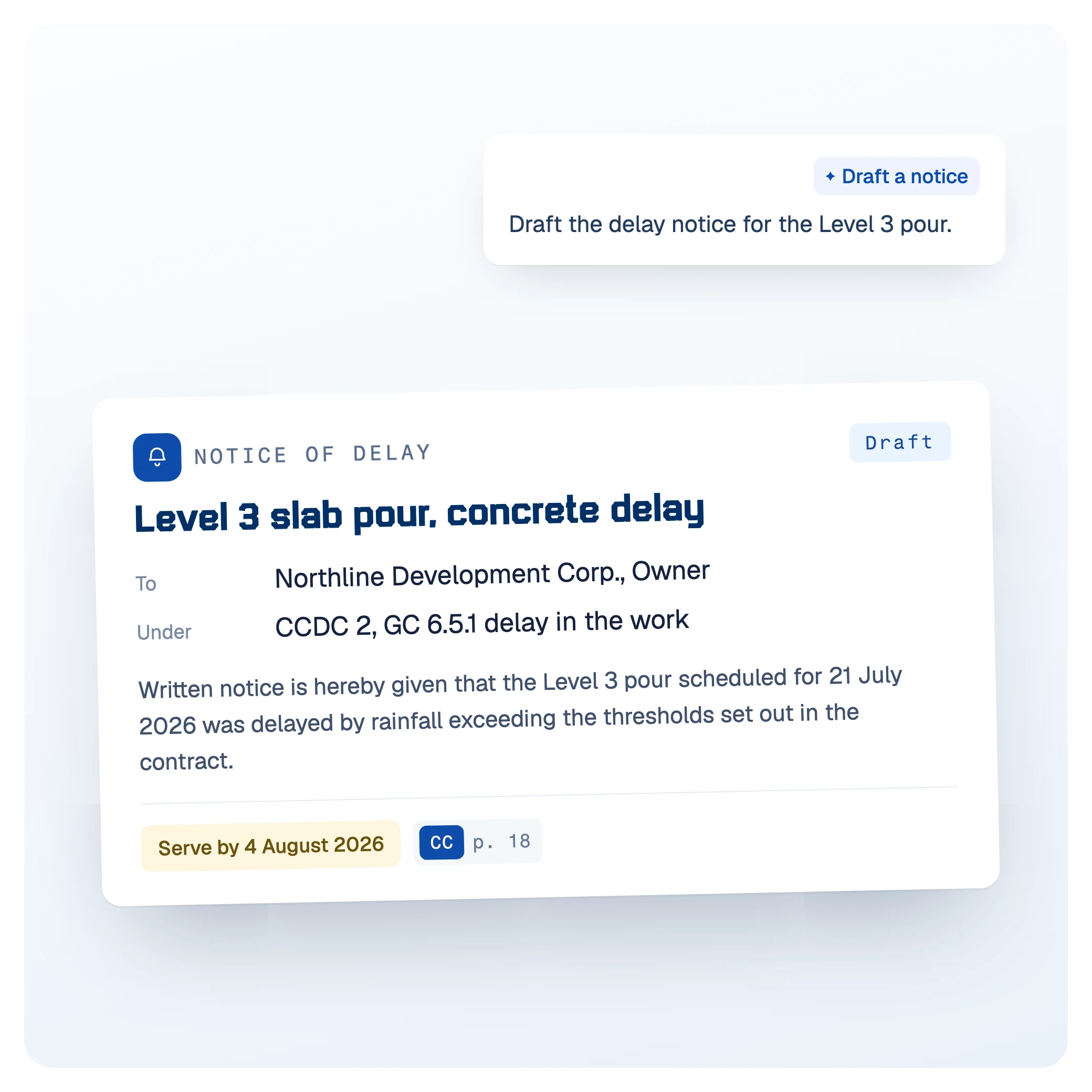
When an event happens on site, Telamont drafts the notice from the clause that requires it, with the dates and the source, so the notice goes out in time and stays on file if a claim follows.
This article is general information. Check the signed contract and the law that applies to your project before acting on a specific change order.
FAQ
What is the most common cause of change order disputes?
Disagreement over the base scope comes up most often: the contractor sees new work, the owner sees work that was already included. For a GC, the dispute often runs both ways, with the sub's exclusions on one side and the owner's reading of the prime contract on the other.
What should a GC check before signing a change order?
The price and time, the backup the owner will expect, and the release paragraph. If the release covers delay or cumulative impact and the full effect of the change is not yet known, reserve those rights in writing before signing.
Can a contractor lose the right to be paid for a change?
Yes. Many contracts make written notice within a set number of days a condition for extra money or time, and a signed change order with broad release language can settle costs the contractor had not yet counted. The exact effect depends on the contract wording and the law that applies.
Are verbal change orders enforceable?
It depends on the contract and the jurisdiction, but most commercial contracts require written authorization before changed work starts. A written record of every field direction, made the same day, protects the GC with both the owner and the subs.
Who pays the subcontractor while a change order is disputed?
Often the GC, at least for a while. Subcontracts may include pay-when-paid or pay-if-paid terms, but subs expect payment for work done on the GC's direction, and the GC carries that cost until the owner approves the change.
Sources
- OIG Releases Audit Recommending Improvements to the Public Building Commission Construction Change Orders Process, City of Chicago Office of Inspector General, June 12, 2018
- Bell BCI Co. v. United States, No. 2008-5087, U.S. Court of Appeals for the Federal Circuit, June 25, 2009
See Telamont on a project like yours
In 30 minutes, we walk you through a project similar to yours: the risks Telamont finds, the clause behind each one, and the notice it drafts for your team.