
Construction document management vs. document intelligence: what is the difference?

Document management tells a team where the file is, document intelligence tells it what matters across the files, and risk intelligence adds who owns each risk and what happens next.
Over the past decade, construction teams have moved their documents into systems of record: one place for drawings, one for the contract, one for RFIs and submittals. Those systems made project documents far easier to find, share and version. They also raise a question we hear often from directors of construction and VPs of operations looking at document AI: how is this different from what we already have in Procore, Autodesk or SharePoint?
The clearest answer is three levels. Document management tells a team where the file is. Document intelligence tells it what matters across the files. Risk intelligence adds why it matters, who owns it and what has to happen next. Each level answers a different question, and a team that has the first one well in hand can still be missing the other two.
1. Document management: here is the file
A document management system is the project's system of record. It holds every file in one place, tracks each revision, controls who can open what and keeps a trail of who received which version and when. When someone asks which drawing was current on March 3, or whether the mechanical subcontractor received the latest set, the system answers with a record.
Document control adds discipline on top: numbered revisions, issue statuses such as issued for bid or issued for construction, transmittals and approvals. Good platforms do this job well.
The limit is one of design. Storage and retrieval work on the file as an object, with its name, version, owner and audience. They were built to keep the set in order, so they have no way to notice that two current, correctly filed documents say different things.
2. Document intelligence: here is what matters across the files
Document intelligence works on content. It reads the plans, specifications, contract and correspondence as one set and keeps the links between them: which spec section governs which drawing note, which clause touches which scope, which revision changed what. A project manager can ask a question in plain language and get an answer that points to the page it came from.
Its most useful output is the flag. A spec requirement that a drawing note contradicts, a scope item that appears in one document and nowhere else, a revision that changes a quantity without changing the text that depends on it. These are errors and omissions in the documents, and they sit inside files that are perfectly well organized.
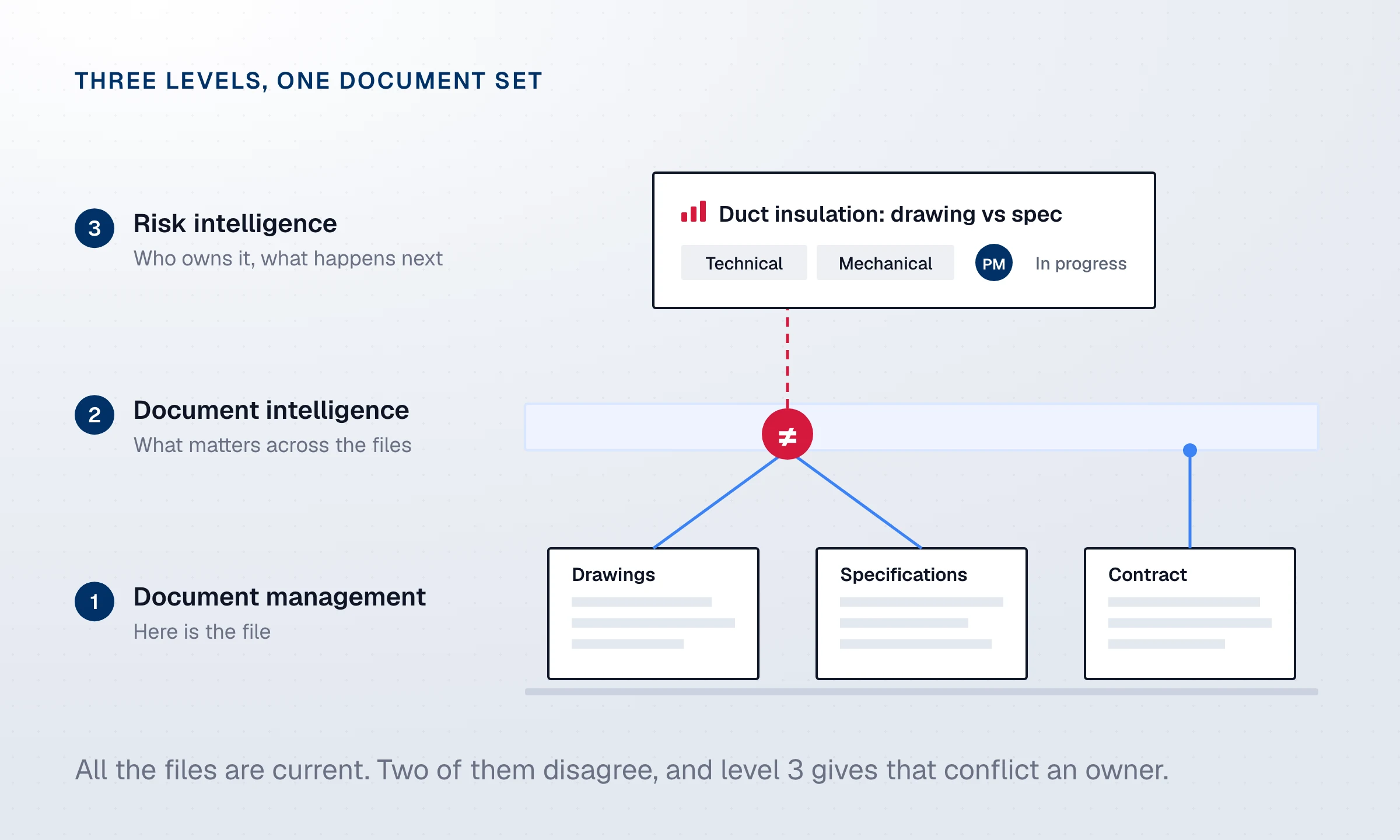
3. Risk intelligence: what matters, who owns it, what happens next
A flag on its own is a note with no owner. Risk intelligence turns each finding into a risk the team can manage: a category (contractual, technical or code compliance), a priority, the trades it affects and a short summary of why it matters on this project, with the source page one click away.
From there, the work is about ownership. Each risk should have a named person, a status and an outcome the team decides: eliminated, mitigated, shared with another party or tolerated. The value of a risk is the team's call, since only the people running the project know what it means for their margin and their schedule.
This level matters most to the people who answer for outcomes: project directors, risk and claims managers, legal counsel. A conflict that is flagged and then lost in an email thread has not been handled, and a month later nobody can say who decided what.
A worked example: the right drawing, the wrong answer
Take the mechanical package on a mid-rise building. The document management system shows that revision 3 of the ductwork drawing is current and that every trade received it. The specifications, issued earlier, call for a different insulation on the same ductwork than the drawing notes show. Nothing is misfiled, nothing is out of date, and the conflict is still there.
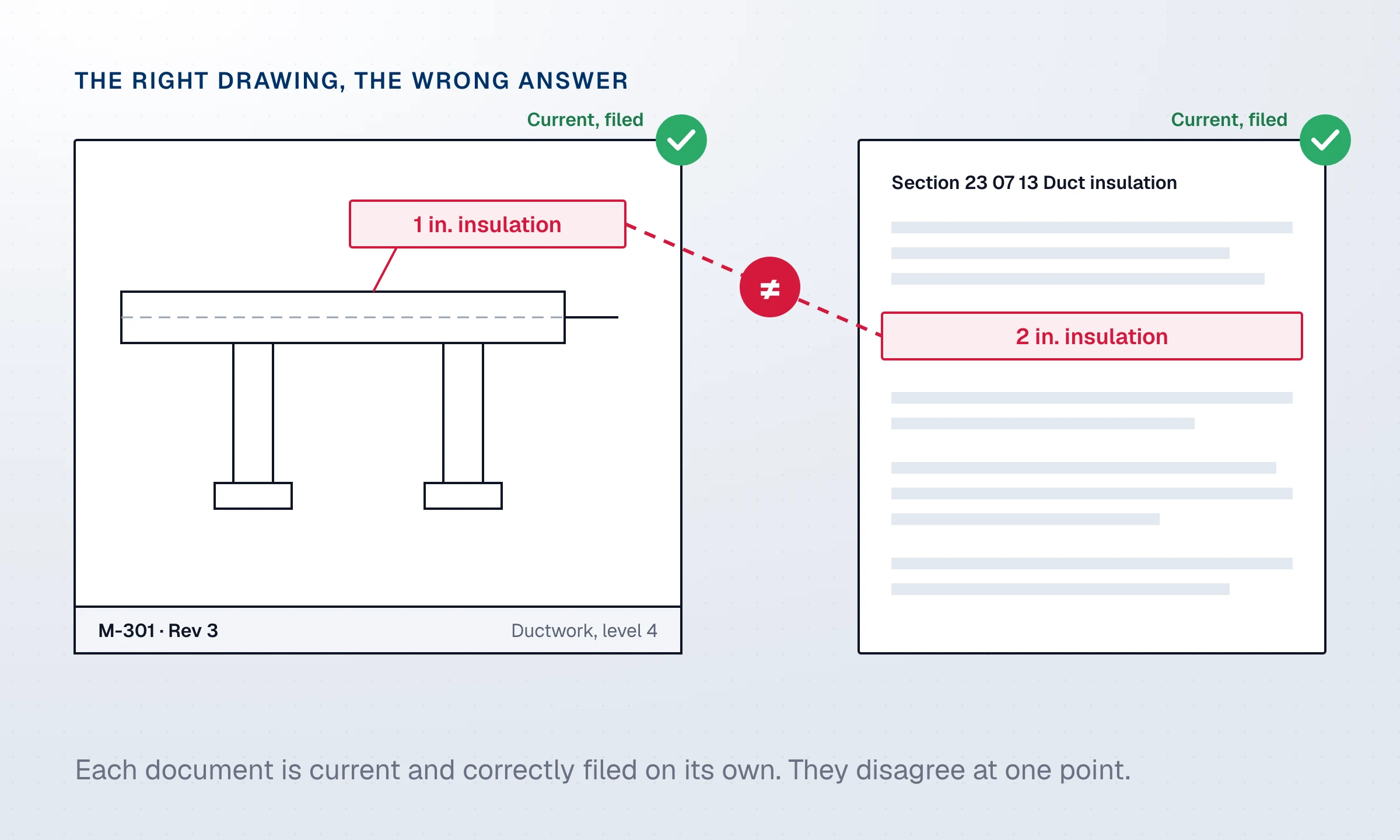
Each level sees something different. The first confirms which drawing is current. The second flags that the drawing and the spec section disagree and links both pages. The third records a high-priority technical risk for the mechanical trade, assigns it to the project manager before buyout and keeps it open until the engineer's answer settles it.
A well-organized document set can still contradict itself, and filing it neatly does not show where.
Without the second and third levels, the same conflict usually surfaces as an RFI from the field, after the subcontract price is set. Raised at the desk before pricing, it is a short question for the engineer. Once the work has started, the same question can turn into a change order discussion.
Why the gap matters
Research on rework has pointed at the documents for a long time. In a study of two Australian building projects published in Construction Management and Economics, Peter Love and Heng Li measured rework at 3.15% and 2.40% of contract value. Changes initiated by the client and end users, together with errors and omissions in the contract documentation, were its main causes.
The sample is small and the study is dated, so the direction is what to take from it: a large share of what gets rebuilt in the field was already wrong on paper. Those errors and omissions rarely hide in a missing file. They sit between files that each look correct, which is where storage has nothing to say.
How to tell which level a team needs
A team that struggles to find the current drawing, loses track of who has which revision or cannot prove what was sent has a management problem. A system of record or stronger document control fixes it.
A team that learns on site that two documents disagree, that a scope item fell between two trades or that bid assumptions no longer match the final set has a reading problem, and more storage will not change that.
A team that does find conflicts but cannot say, a month later, which ones were resolved, who decided or which ones were passed to a subcontractor has a risk problem. That is the third level, and it usually shows up first in a claim or a closeout.
Most teams with a solid system of record have the first level covered. The gap tends to sit in the second and third, and both can work on top of the system the team already uses.
Where Telamont fits
Dedicated construction AI like Telamont works at the second and third levels, as a layer above the project management tools a team already uses. It reads documents from SharePoint, Autodesk, Dropbox or somewhere else, and the system of record stays where it is.
Telamont reads the plans, specifications, contracts and revisions together and flags risks, errors and omissions, each cited to the page it came from. Each risk then goes through triage with a category and a priority, and onto a board where the team assigns it, discusses it and closes it as eliminated, mitigated, shared or tolerated. Risk tracking shows how that board works, with exposure amounts the team enters itself.
FAQ
Does document intelligence replace document management?
No. Document management keeps the official set, with versions, permissions and records of what was sent. Document intelligence reads the content of that set and reports what it finds. Most teams keep their system of record and add the reading layer on top of it.
Can a document management system find conflicts between drawings and specifications?
Search and tagging help a person locate related documents faster. Detecting that two documents contradict each other requires reading and comparing their content, which is the job of document intelligence.
What is the difference between document intelligence and risk intelligence?
Document intelligence finds what matters across the files and flags where they disagree. Risk intelligence turns each finding into a managed risk, with a priority, an owner, a status and a decision the team records.
How is this different from a general-purpose AI assistant?
General-purpose assistants such as ChatGPT, Copilot and Claude can answer questions about a document someone pastes in. A dedicated construction platform keeps the whole project set, links the documents to each other, cites every finding and tracks it over time. The longer comparison is in what dedicated construction AI does that ChatGPT, Copilot and Claude don’t.
Which should a team set up first?
A reliable system of record comes first, because the reading layer works best on a set that is complete and current. Once the set is in order, the second and third levels add the cross-document checks and the follow-through that storage cannot provide.
Sources
See Telamont on a project like yours
In 30 minutes, we walk you through a project similar to yours: the risks Telamont finds, the clause behind each one, and the notice it drafts for your team.