
See what Telamont does that ChatGPT, Copilot and Claude don't
Copilot, ChatGPT and Claude are excellent at writing and summarizing. Telamont reads every document on your project, finds the risks that cost money, proves each one with the clause and the page, and stays with your team until the notice is sent.
If your team already uses Copilot, ChatGPT or Claude, good. Keep them. Telamont does a different job: it reads every document on your project before anyone asks a question, compares them against each other, finds the risks that cost contractors money, proves each one with the clause and the page, and stays with your team until the notice is sent.
We hear one question in demos more than any other: "What does Telamont do that my AI assistant doesn't?" Here is the full answer, point by point, the way we walk project managers and executives through it. For each point you will see how a general assistant works, what Telamont does instead, and what that means on your projects.
Where AI in construction stands
Contractors are moving on AI fast. In the AGC and Sage 2025 outlook, 44% of US contractors named AI as the technology where they planned to increase investment the most, ahead of document management. Investors agree: venture funding in construction technology reached about US$6.57 billion across nearly 337 deals in 2025, according to Cemex Ventures.
The question is no longer whether to use AI, but where it pays off. In a 2025 Dodge Construction Network study of 235 US contractors, contract risk review was among the highest-rated uses, at 86% effectiveness among the firms already using AI for it. The same contractors named their top two concerns: the accuracy of AI output (57%) and data security (54%).
The stakes are high. Arcadis's 2026 US Construction Disputes Report puts the average US construction dispute in 2025 at US$56 million, taking 12.2 months to resolve. The two leading causes were parties failing to understand or comply with their contractual obligations, and errors or omissions in the contract documents. Respondents ranked contract and specification reviews among the most effective ways to avoid claims. That is exactly where the choice of AI tool matters most.
At a glance
- Where it starts. A general assistant starts from your question. Telamont starts from every document on the project, read before anyone asks.
- What it reads. A general assistant reads the files you upload to the conversation. Telamont reads the contract, subcontracts, specs, drawings and addenda together.
- Conflicts between documents. A general assistant finds them if you ask. Telamont checks them automatically, with the order of precedence applied.
- Where answers come from. A general assistant mixes your files, its training and sometimes the web. Telamont uses your project documents only and says when something is not there.
- Proof. A general assistant gives you a summary to check by hand. Telamont gives you the document, clause and page, opened in one click.
- After the answer. A general assistant's conversation ends. In Telamont each risk is ranked, assigned, tracked and turned into a notice.
- Who sees it. A general assistant answers the person who asked. Telamont keeps one shared record for the whole project team.
- New revisions. With a general assistant you upload them again. Telamont syncs them from your document systems.
1. Telamont finds the risks you did not think to ask about
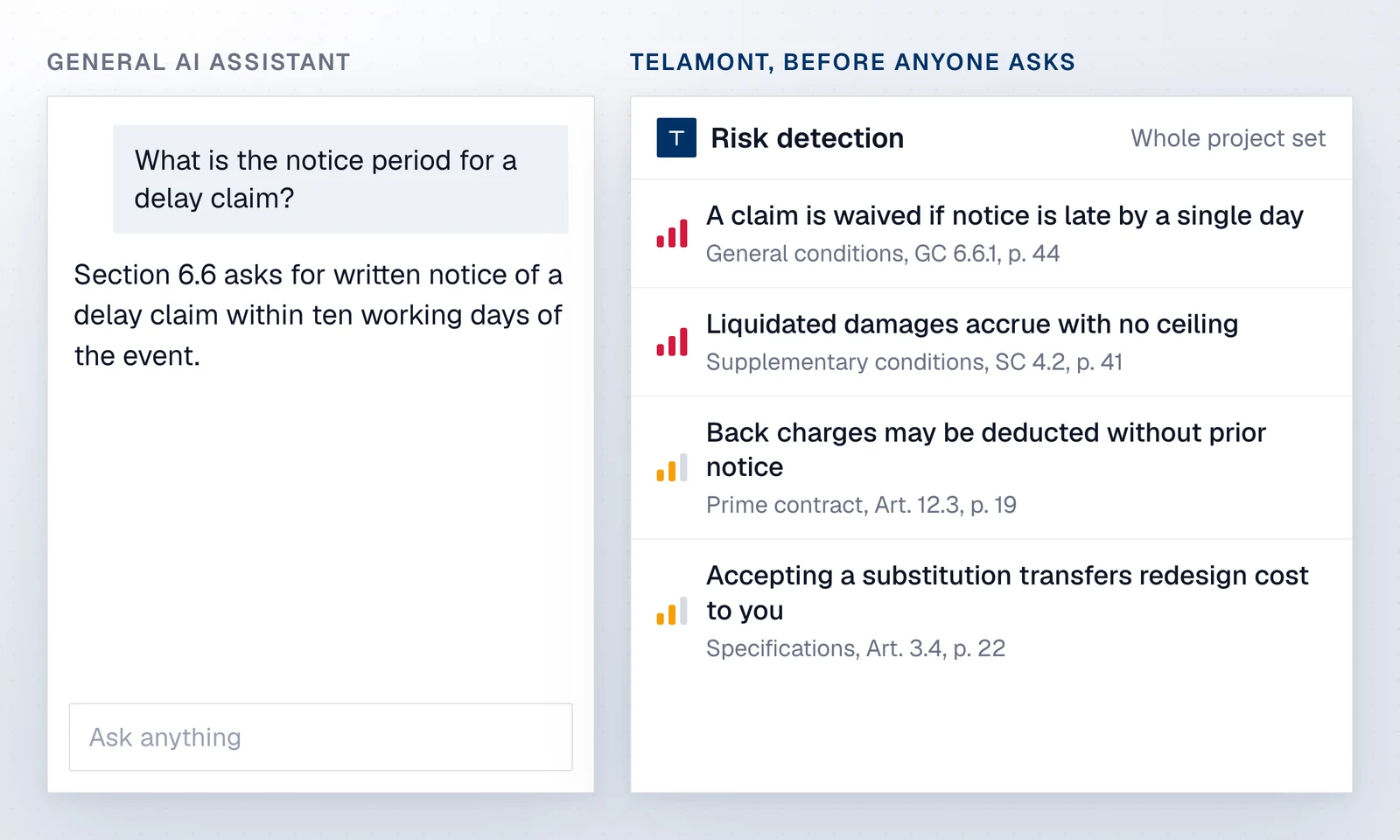
How a general assistant works. You upload a file and type a question. The assistant does not read your 1,500 pages front to back first. It searches the file for passages that look related to your question, reads those, and writes an answer. That is why it answers in seconds, and it is also why it only ever covers what you asked. If nobody asks about the clause that lets the owner deduct back charges without notice, the assistant never brings it up.
The problems that cost the most on a project are usually the ones nobody thought to ask about: the exclusion in a subcontract, the notice period shortened in the supplementary conditions, the spec requirement nobody priced.
There is a second limit most teams never hear about. Researchers at Stanford and other universities showed in "Lost in the Middle" (2024) that language models are measurably worse at using information buried in the middle of a long input than at its start or end. A 2024 benchmark called RULER found that only half of the long-context models tested held up at the input lengths they advertised. A project's spec book is exactly that kind of input: long, dense, and full of clauses that matter in the middle.
What Telamont does. Telamont reads the whole project first. Before your team asks anything, it goes through the contract, the general and supplementary conditions, the subcontracts, the specifications and the drawings. It runs detectors for each risk family you choose: technical, contractual, compliance and schedule. The findings land in a queue sorted by severity, each one tied to its clause. On the projects we have analyzed, that is between 55 and 160 risks with money attached, found before execution.
What that means for you: your team starts Monday morning with a ranked list of what needs attention, instead of a blank prompt and a guess about what to ask.
2. Telamont checks every document against all the others
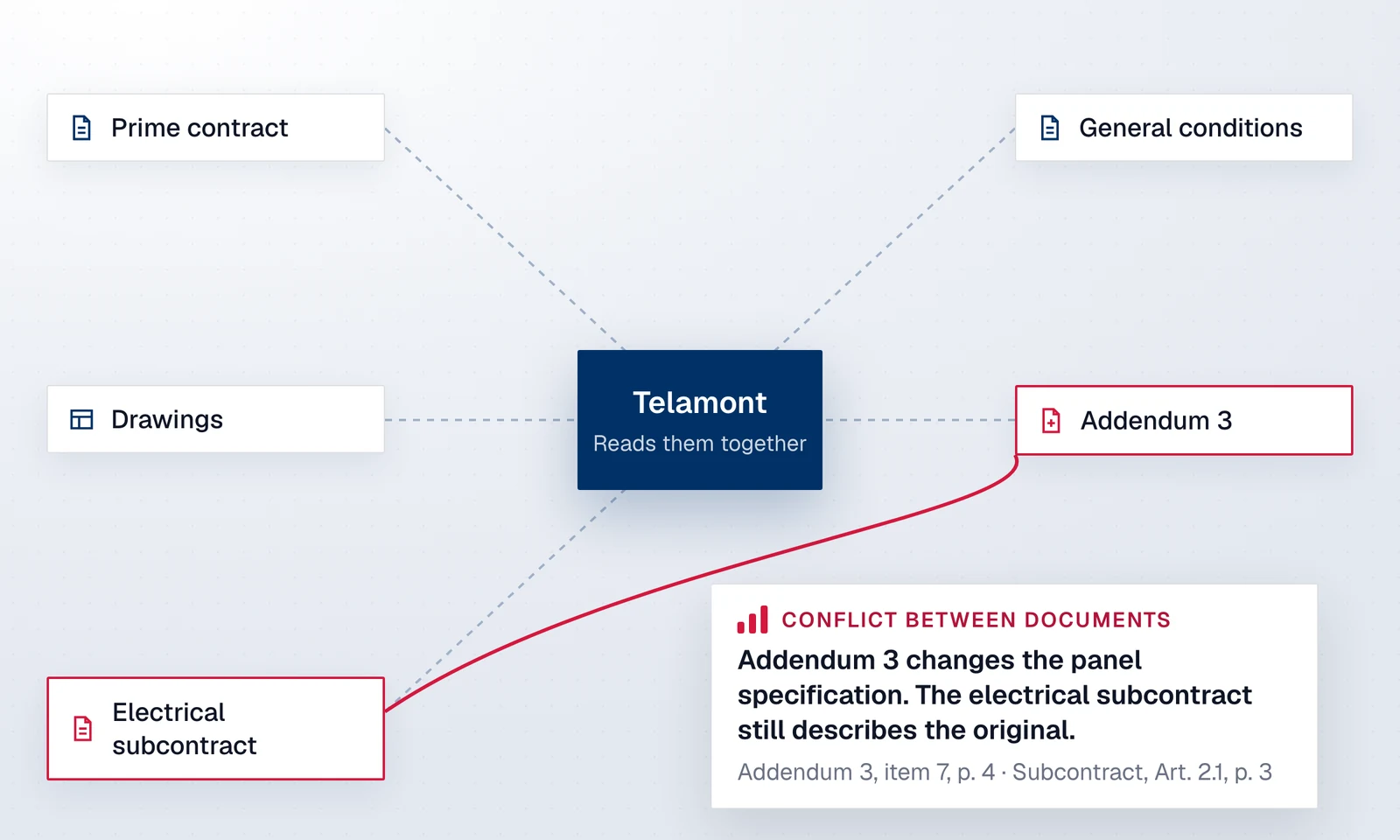
How a general assistant works. Construction documents do not stand alone. The supplementary conditions rewrite the general conditions. Addendum 3 changes a spec section. The subcontract is supposed to carry the owner's requirements down to the trade. To get the right answer, you need all of them read together, with the contract's order of precedence applied.
A general assistant answers from the passage it finds first. If the document that overrides it was not uploaded, or sits 800 pages later in another file, the answer still reads well. It is simply wrong, and nothing on the screen tells you.
This is not a small problem. Errors and omissions in the contract documents were the second leading cause of US construction disputes in 2025, according to Arcadis. And every conflict that reaches the field becomes an RFI: a 2013 Navigant review of 1,300 major projects counted an average of 796 RFIs per project, at about US$1,080 each to review.
What Telamont does. Telamont treats the project as one set of documents. It reads every document against the others and applies the order of precedence written in your agreements, not a generic rule.
- It compares the prime contract with every subcontract and shows what did not flow down.
- It checks specs against drawings: dimensions that do not match, a detail missing from one discipline, space conflicts.
- It checks both against the building code, the standards it references, local amendments and your master specifications.
- It checks the schedule against the contract: milestones, delay penalties, imposed sequences.
When one passage is contradicted somewhere else, Telamont flags the conflict and cites both sides.
What that means for you: you find the gap between your contract and your subcontract while it is still a conversation with your sub.
3. Every answer comes from your documents, with the page to prove it
How a general assistant works. A general assistant blends three sources into one answer: your files, what it learned in training, and, in many versions, a web search. The answer is fluent either way, so you cannot tell which sentence came from your contract and which came from somewhere else. Contractors have told us about a bid-leveling agent that started inventing numbers, and about a code book of more than 1,000 pages where the assistant could not find the exception they needed. When the answer decides whether you send a notice, you need to know where it came from.
Research backs this up. A Stanford study found that general-purpose chatbots produced wrong answers between 58% and 82% of the time on legal research questions. The same researchers found that even purpose-built legal AI tools got more than 1 in 6 questions wrong. The lesson is not to avoid AI. It is to use AI that shows its source, so a person can check every answer before acting on it.
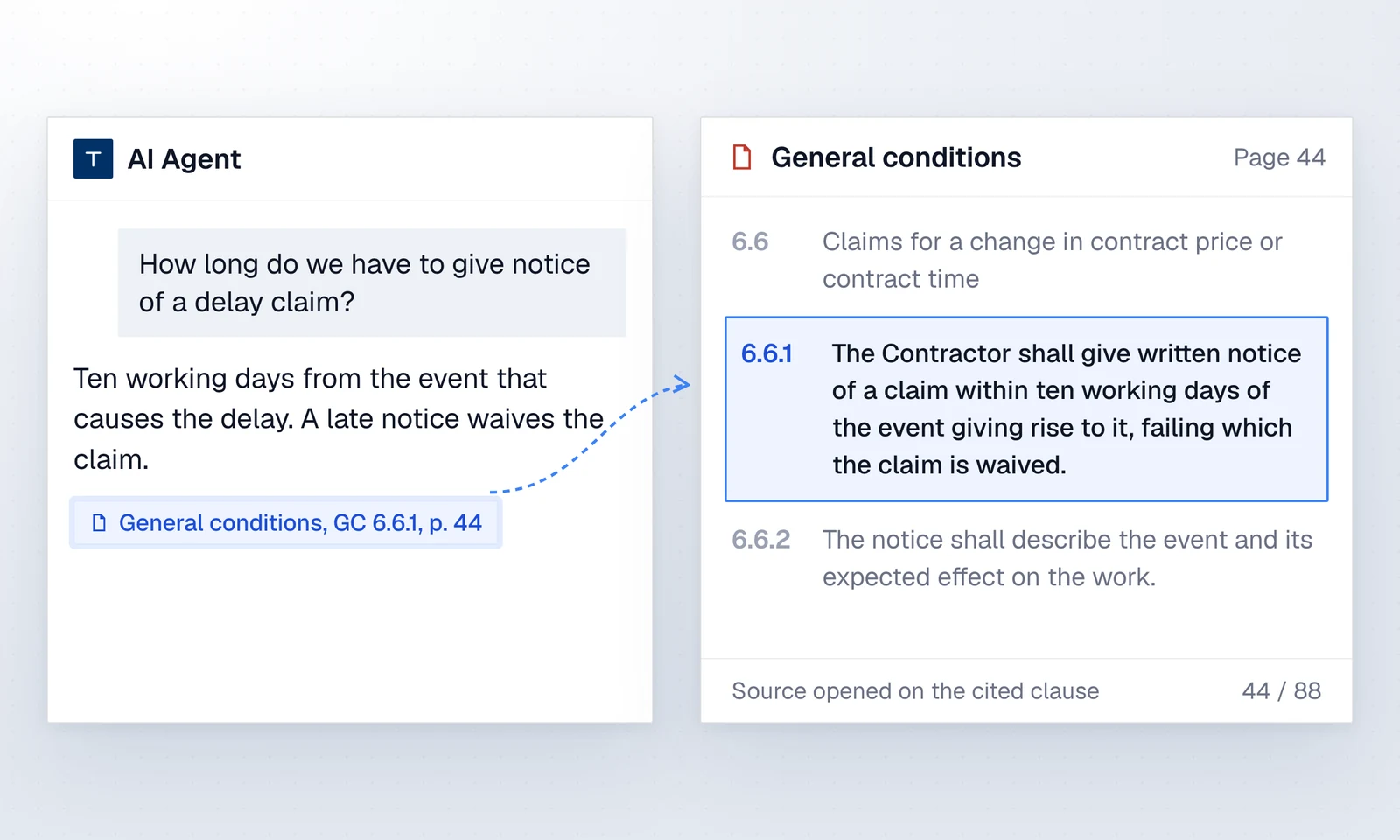
What Telamont does. Telamont answers from your project documents and nothing else. It is not connected to the internet. When the answer is not in your documents, it tells you it did not find it, instead of filling the gap. Every answer and every finding shows the document, the clause and the page, and one click opens the source on that exact passage.
Ask "What is the fire rating on the demising wall at grid F-4?" and you get the assembly, two layers of Type X gypsum each side, with Division 09, page 231 open on the paragraph. Ask it in writing at your desk, or out loud on site with voice mode. And the AI Agent does more than answer: ask it to build a table of every notice deadline in the prime contract, compare two versions of a document or draft a delay notice, and it does the work, with every line cited.
What that means for you: your project manager checks the source directly and walks into the owner meeting with the clause in hand.
4. Your team works from one set of findings
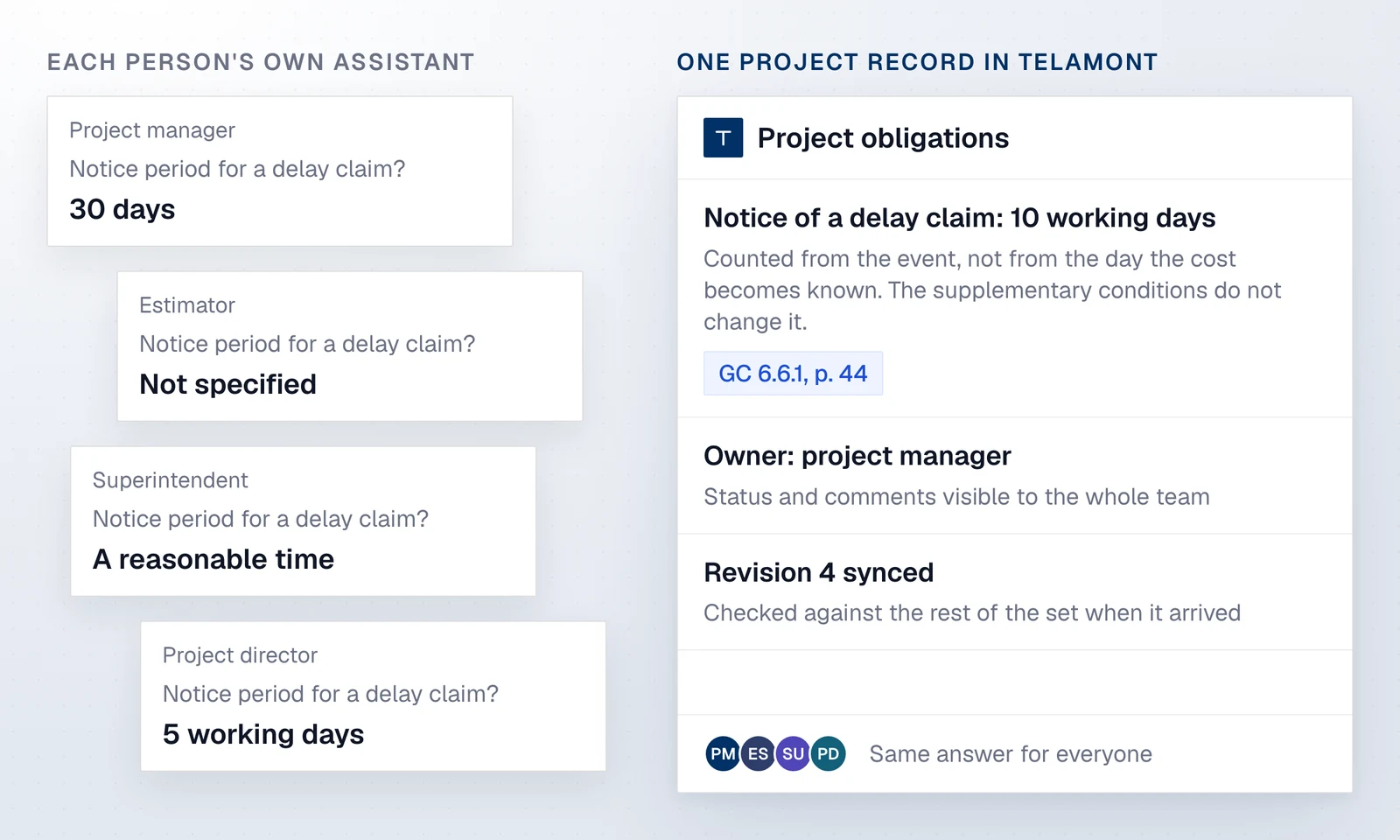
How a general assistant works. Ask a general assistant the same question twice and you can get two answers. Ask it in Copilot, ChatGPT and Gemini and you will get three. That is by design: every conversation starts fresh, and the model writes a new response each time. Your estimator, your project manager and your project director each end up with their own version of what the contract says. It is fine for drafting an email. It is a problem when the answer decides whether you send a notice.
The model makers say so themselves. OpenAI's developer documentation states that "determinism is not guaranteed": identical requests can return different responses.
What Telamont does. Telamont runs the same detectors, with the same construction rules, on every document, and saves the findings once for the whole team.
Boards take it further. You pick the questions that matter on the project from more than 50 ready-made cards: notice periods, penalties, payment terms, order of precedence, bonding, exclusions. The board fills itself in with the clause it found, what that clause requires and the deadline already running. Save the board as a template, and your next project gets the same review with the same rigor. Share it with one link, or export it as a PDF for a site meeting or a claim file. When a new revision arrives, Telamont checks what changed and what that change affects elsewhere.
What that means for you: everyone from the site to the office works from the same answer, on every project you run.
5. Telamont already knows how construction documents work
How a general assistant works. A general assistant knows a little about everything. To get a good contract review out of it, you have to teach it construction in the prompt: which document governs, when a notice clock starts, what a flow-down clause should carry, which exclusions are unusual for your trade. The quality of the answer depends on the person typing, and nobody writes that prompt the same way twice.
What Telamont does. Think of Telamont as a new hire who already knows construction. It knows which document governs when the spec and the drawing disagree, which notice clock starts at discovery and which starts at the event, and what an exclusion in a subcontract actually shifts. We build that judgment in, clause by clause, with engineers, architects, construction lawyers and general contractors who review what the system produces and tell us where it is wrong.
You tick the risk families that matter on this project, and Telamont applies them. Your project manager asks in plain words and gets the clause back. There is no prompt to write and no context to set up.
What that means for you: the review is as thorough on your newest coordinator's project as on your most senior PM's.
6. Telamont takes each risk from finding to notice
How a general assistant works. A conversation with a general assistant ends with an answer. The rest of the work happens outside the tool: someone copies the answer into a log, decides who owns it, works out the deadline, writes the notice, finds the clause to cite and files a copy. Every handoff is a place where a date or a clause can slip.
That gap is where disputes start. The leading cause of US construction disputes in 2025, according to Arcadis, was a party failing to understand or comply with its contractual obligations. Knowing about a notice clause is not enough: someone has to own it and act on it in time.
What Telamont does. In Telamont, the finding is where the work starts, and the risk keeps its clause and its history all the way to the notice.
- Risk triage ranks every risk by what it can cost in money and in days, so you know which one to start with. Dismissing a risk is a recorded decision, with its author, its date and the clause invoked, so you can defend it eighteen months later.
- Risk tracking gives each risk one owner, one status and one due date. The clause that triggered it stays one click away.
- Notice drafting writes the notice from the risk and the clause that requires it. The project, the clause and the dates carry over, so nothing is retyped.
- The Notice Score checks the draft on four points before you send it: the facts, the contract citation, the documented impact, and the request and deadline. Tell it in one line what to fix, and it rewrites the notice and scores it again.
- The notice goes out from your usual mailbox and is kept in the project's notice register, dated, with its author.
What that means for you: you build the claim file during the project, while the facts are fresh.

7. The whole team works from one record
How a general assistant works. When a company rolls out a general assistant, every person builds their own chats, prompts and custom agents. Nothing is shared, nothing is standardized, and when someone moves on, their work goes with them. Several contractors told us this is where they are today: everyone has their own AI tool and there is no common standard.
Scattered information already costs the industry a lot. In the PlanGrid and FMI "Construction Disconnected" study, construction professionals reported spending 5.5 hours a week looking for project data, and bad project data caused 48% of rework on US projects. Personal AI chats add one more place for project knowledge to scatter.
What Telamont does. Telamont keeps one record per project. Findings, decisions, owners, comments, boards and notices sit in one place. The project manager, the superintendent, purchasing and management see the same status at the same time. When someone moves to another project, the decisions and their history stay on file.
Telamont connects to the document systems your team already uses, so new revisions arrive on their own and every answer uses the current version. Alerts go to the tools your team already works in.
What that means for you: a new team member gets up to speed on a project in minutes, from the same record everyone else uses.
8. Your documents stay private
How a general assistant works. Many contractors block public AI tools at work, or tell staff not to upload contracts to them. That is a sensible rule. A consumer chat account is not built to hold your contracts, pricing, correspondence and claim strategy, and what happens to the files you upload depends on the plan and the settings of whoever uploaded them.
What Telamont does. Telamont is built to hold project documents. We do not use your project data to train shared or public models. Data is encrypted in transit and at rest, kept only as long as the product needs it, and protected by least-privilege permissions and strong authentication, including SSO. Your administrators control users, permissions and access. Our AI principles set out how we handle your data.
What that means for you: your IT team gets a tool it can approve, and your project team gets AI it is allowed to use on real contracts.
9. Reliable answers on a whole project take an engine around the model
Most teams judge AI by the model: which one writes better, which one is newer. On a construction project, the model matters less than you would think. What makes an answer reliable is everything that happens before and after the model writes it.
Before the answer: every document has to be read and indexed, not sampled. Revisions have to replace the versions they supersede. The documents have to be compared against each other, with the order of precedence applied, so the answer reflects the whole contract and not the first passage that matched.
After the answer: it has to point to its source so someone can check it, be saved where the whole team sees it, and turn into action: an owner, a deadline, a notice.
Telamont is that engine. It runs leading AI models, chosen for each task, inside a system built for construction documents. That is why the same platform can find a risk on page 812, prove it with the clause, and get the notice out before the deadline.
Some contractors start by building custom GPTs or agents for their projects, and it is a good way to learn what AI can do. The work grows quickly after the first demo: keeping every project indexed as revisions arrive, applying the same construction rules on every job, citing every answer to the page, and running a shared workflow from finding to notice. Telamont does that work full time, so your team can spend its time on the projects.
Where ChatGPT and Copilot shine on a construction team
General assistants are some of the most useful tools a contractor can give its office staff, and we use them every day. They save real time on work like this:
- Writing and rewording emails, letters and meeting minutes
- Drafting bid narratives, qualifications and proposal sections
- Translating correspondence for owners, subs and crews
- Building spreadsheet formulas and cleaning up estimate data
- Preparing toolbox talks, job postings and training material
- Brainstorming a schedule recovery plan or a value-engineering idea
Your project documents are a different job. When the question is "what in this contract, these specs and these drawings can cost us money, and are we on time to act on it?", you need every document read and compared, a source behind every answer, and a record your whole team shares. That is the job Telamont is built for. Book a demo to see it on a project similar to yours.
FAQ
What does Telamont do that Copilot, ChatGPT or Claude doesn't?
It reads every document on the project before you ask, compares them against each other with the contract's order of precedence, cites the clause and page for each finding, and manages each risk through to the notice. A general assistant answers the question you ask about the files you upload.
We already pay for Copilot. Why pay for another tool?
Copilot helps each person write and search. Telamont protects the margin on a project by finding the contract, technical and compliance risks across the full document set and tracking them until they are settled. One missed notice period or unpriced requirement usually costs more than the software.
Can't I just upload the contract to ChatGPT and ask it to find the risks?
You can, and it will find some. It will read only what you upload, answer differently on another day, and leave you to check every point by hand. It also cannot see the conflict between that contract and a subcontract or addendum you did not upload.
Should we stop using ChatGPT or Copilot?
No. Keep them for writing, translation, spreadsheets and everyday office work. Use Telamont for the project documents: finding the risks, proving them with the clause and acting on them before the deadline.
What should we ask any AI vendor for construction documents?
Ask whether it reads every document together or one at a time, whether every answer cites the document and page, whether it applies your contract's order of precedence, whether the whole team shares one record, and whether it trains models on your data. Our guide on how to evaluate AI construction risk software has the full scorecard.
Can we build this ourselves with custom GPTs or agents?
You can build an agent that answers questions about files. Keeping every project indexed and current, applying the same construction rules on every job and running a shared risk workflow is a software product to maintain. Telamont does that work so your team can focus on the projects.
Is it safe to put our contracts in Telamont?
Yes. Telamont does not train shared or public models on your data, encrypts it in transit and at rest, and supports SSO and least-privilege access.
Sources
- AGC and Sage, 2025 Construction Hiring and Business Outlook, January 2025
- Cemex Ventures, Top 50 Contech Startups 2026, reported by World Cement, February 2026
- Dodge Construction Network and CMiC, AI for Contractors, December 2025 (235 US contractors using AI tools)
- Arcadis, 2026 Construction Disputes Report, United States (dispute value is the amount claimed)
- Liu et al., Lost in the Middle: How Language Models Use Long Contexts, TACL, 2024
- Hsieh et al., RULER: What's the Real Context Size of Your Long-Context Language Models?, COLM 2024
- Stanford HAI, AI on Trial: Legal Models Hallucinate in 1 out of 6 (or More) Benchmarking Queries, May 2024
- OpenAI, Reproducible outputs with the seed parameter
- STRUCTURE magazine, Steering Clear of Trouble, citing a 2013 Navigant study of 1,300 projects
- PlanGrid and FMI, Construction Disconnected, 2018
See it on one of your own projects