

Risk detection
Find contradictions across the contract, the specs and the drawings.
↳ Telamont reads them together, catches what does not line up, and cites every gap to the exact article, while it can still be settled with an email.

A detector for every type of risk.
Technical risks
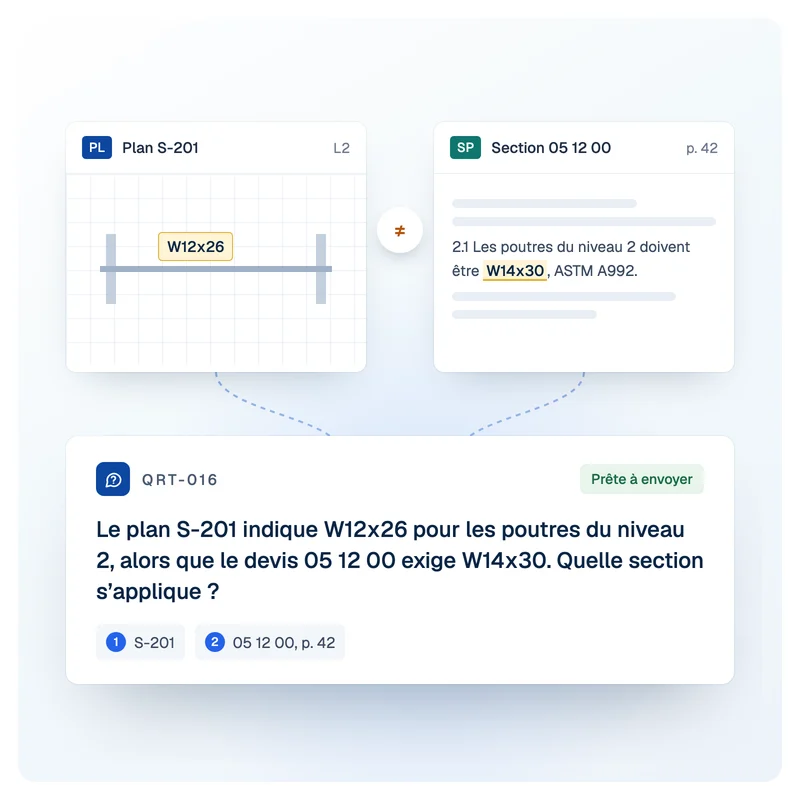
Reads drawings and technical specifications, and surfaces inconsistencies between disciplines: space conflicts, dimensions that do not match, a detail missing from a section.
Contractual risks
Cross-checks contracts against subcontracts: contradictions, order of precedence, notice periods, exclusions and limits of liability.
Compliance risks
Checks documents against the applicable building code, the standards it references, local amendments and your master specifications.
Schedule risks
Cross-checks the schedule against contractual obligations: milestones, delay penalties, imposed sequences.

Proactive analysis
The work nobody priced and the clauses that contradict each other, caught before it gets expensive.
Back charges may be deducted without prior notice
Amounts can be set off against your next progress claim before you see them.
Investigate
Add to Operations
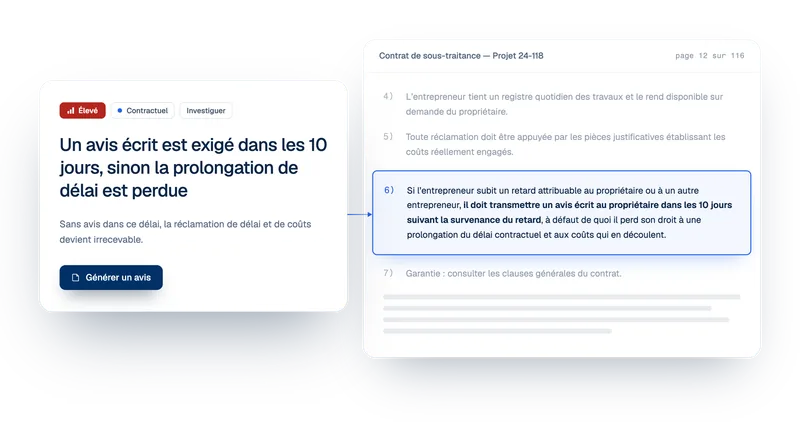
A claim is waived if notice is late by a single day
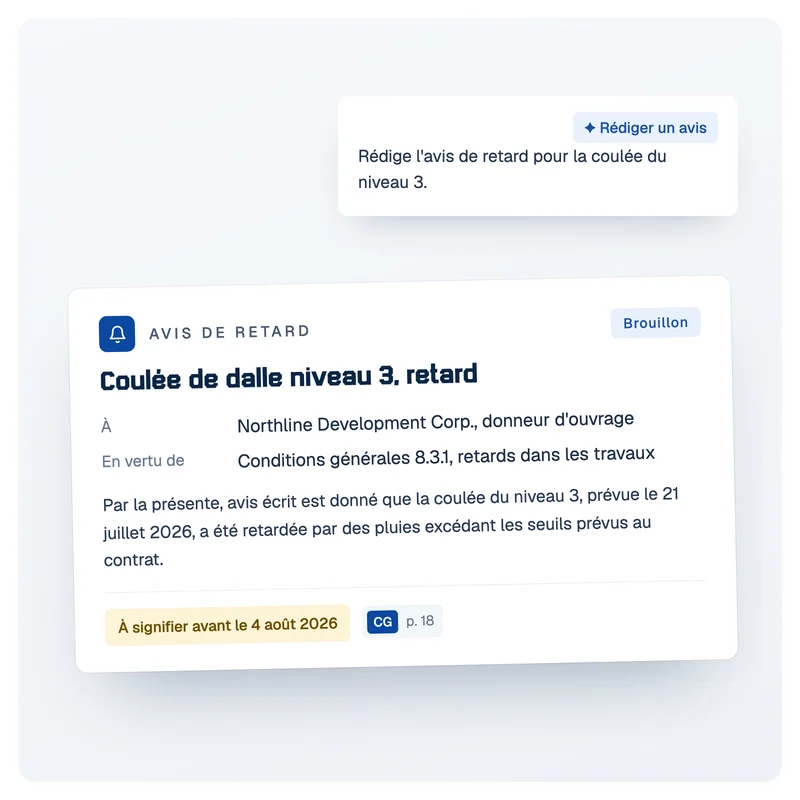
Ten working days from the event, not from the day the cost becomes knowable.
Investigate
Add to Operations
Consultant review time is excluded from extension of time claims
Standard in the general conditions and already built into your schedule: worth confirming, not chasing.
Investiguer
Archiver
Accepting a substitution transfers all redesign cost to you
The substitution is approved, the coordination and resubmittal work is not priced.
Investigate
Add to Operations
Liquidated damages accrue for every day of delay, with no ceiling
Every calendar day between the contract completion date and substantial performance is deducted, without limit as to amount.
Investigate
Add to Operations
Hot work cannot start before the fire safety plan is accepted
Approval sits with the authority having jurisdiction and the schedule holds no float for it.
Investigate
Add to Operations
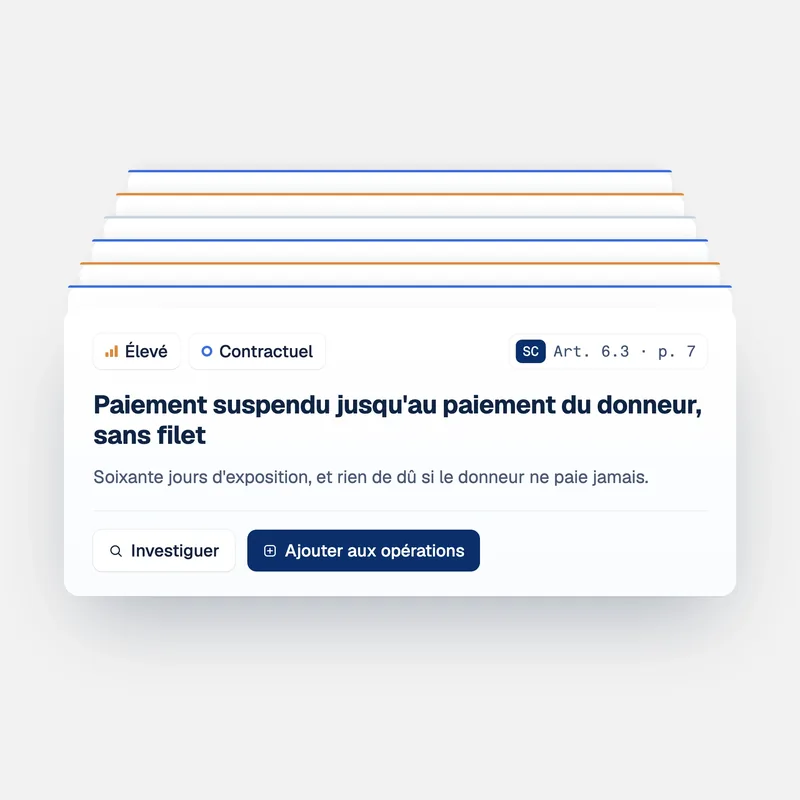
Payment suspended until the owner pays, with no backstop
Sixty days of exposure, and nothing owed if the owner never pays at all.
Investigate
Add to Operations
No risk found
Find the problem while it can still be settled with a conversation.
A contradiction caught at tender is fixed by email. The same contradiction six months later is settled as a claim.
73 %
less risk of ending up in a claim
80 %
of risks flagged earlier, before execution
160
monetisable risks found on a $25M project (55 to 160 depending on the project)
No notice deadline missed on the project
A defensible position, clause in hand
Critical risks handled first

Step 1 · Choose the documents
Pick the documents to cross-check
Telamont lists the documents already in the project, by type. Tick the ones to read together, from one subcontract to the whole project.
- Read the contract, the subcontracts and the specs together
- Check one new subcontract or the whole project
- Start from the documents already in the project
Step 2 · Choose what to check
Pick the playbooks that matter on this project
Each playbook is a set of checks on one subject: payment, schedule and delay, code compliance. Add the ones that matter, then run the detection.
- Payment, schedule and delay, code compliance and more
- Choose the building code to check against
- See the number of pages and the estimated time before you start
Step 3 · Review
Get every risk with its priority, category and source
Each risk comes with a priority, a category and the document it comes from, so the team knows where to start.
- The high-priority risks first
- Contractual, technical and compliance risks in one list
- Each risk tagged with the trades it affects
Step 4 · Verify and act
Open a risk and read the clause in the document
Each risk opens next to its source document, with the exact passage highlighted. Then you decide what happens to it.
- The exact passage highlighted in the source document
- Add it to operations or archive it in one click
- Ask the agent to investigate further
Results
Risks found before the work starts, not after
Telamont reads every document against the others. Your team decides what to do with each risk, clause in hand.

Fewer surprises on site
Contradictions between the contract, the specs and the drawings surface before execution.

Deadlines in view
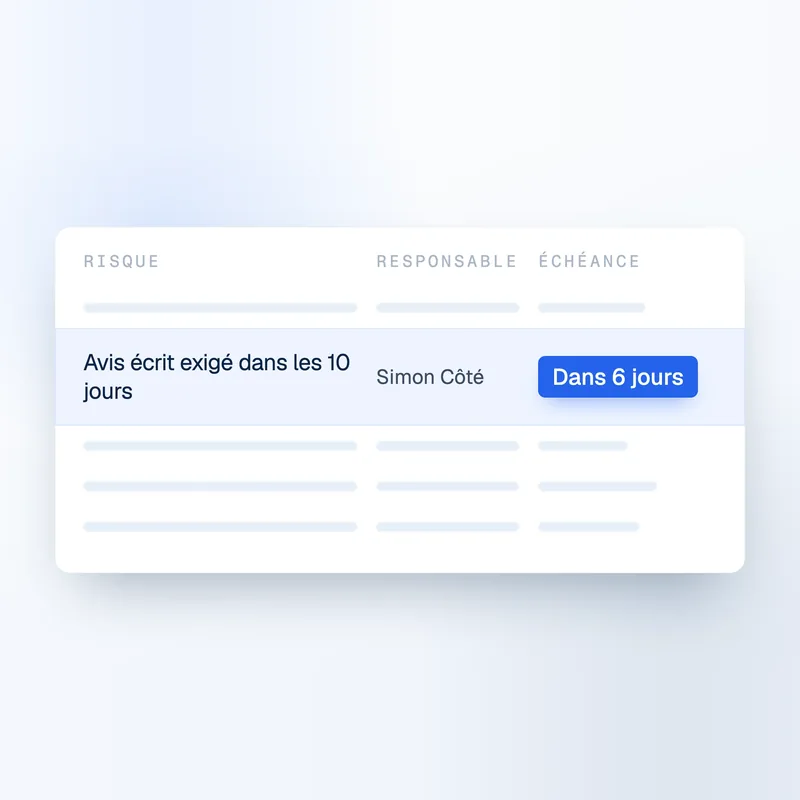
Notice periods and time bars are flagged as soon as the contract is read.

Margin protected
Unpriced work and payment terms that hold back cash show up before you sign or build.

Faster review
Hundreds of pages cross-checked in minutes, so the team reviews findings instead of reading.
FAQ
Frequently asked questions about construction risk detection

What is construction risk detection?
Construction risk detection is the review of project documents to find what can cost time or money before it happens: contradictions between the contract, the specs and the drawings, short notice deadlines, payment terms that hold back cash, requirements below the building code. Telamont reads the documents together and lists each risk with its priority, its category and the passage it comes from, so your team can act while there is still time.
Which documents can Telamont cross-check?
Prime contracts, subcontracts and technical specifications, along with the drawings and building codes they refer to. You pick them in the project, by type, and Telamont reads them together rather than one by one. That is how it finds a subcontract clause that contradicts the prime contract, or a drawing that does not match the spec section for the same work.
What is a playbook?
A playbook is a set of checks on one subject. Payment looks at how and when you get paid, Schedule and delay looks at notice periods and extensions of time, and Code compliance checks the documents against the building code you select. You add the playbooks that matter on the project before running the detection, and each risk found shows the playbook that flagged it.
How long does a detection take?
A few minutes. Before you start, Telamont shows the number of pages to analyze and the estimated time, for example about four minutes for 120 pages. The run then appears in the detection list with its status, and once it is complete, with the number of risks found.
How do I know a finding is right?
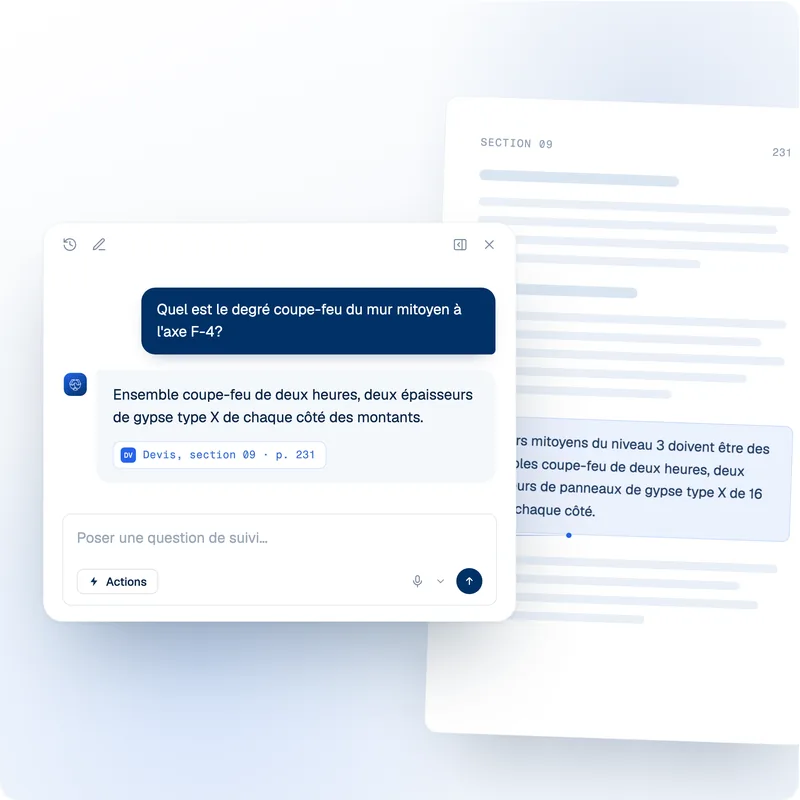
Every risk cites its source: the document and the page it comes from. Open the risk and the passage is highlighted in the document, next to the summary Telamont wrote. Your team reads the clause, then adds the risk to operations or archives it. Telamont surfaces the risks, and the decision stays with your team.
Can we run a detection before signing a subcontract?
Yes. A subcontract still at the request for proposal stage can be checked like any other document. Run it with the prime contract to see what the subcontract leaves out or contradicts while the terms can still be negotiated, rather than after the work has started.
The product
Explore the other features.


Contact

Product
Solutions