

How do subcontract scope gaps appear in the documents, and how do teams spot them?

Scope gaps appear where trade packages meet and where documents disagree. Courts settle who pays by reading the documents, so the check belongs before subcontracts are signed.

A scope gap is work the project requires that no subcontract covers. Someone still has to build it, and someone pays for it. When two subcontractors each say the work belongs to the other, Civil Engineering, the ASCE magazine, notes that the general contractor is the party likely to carry that ambiguity.
Two recent court cases turned on the same work, excavation and backfill for electrical conduit, and ended in opposite places. In both, the court read the documents and set trade custom aside. That is why the check has to happen on the documents, before subcontracts are signed.
Where scope gaps come from
Plans, specifications and contract conditions are written by different people at different times, and each one divides the work its own way. When a general contractor splits that material into trade packages, the seams of the split are where work goes missing.
Bid windows make the seams harder to see. Each estimator owns a few trades, and the cross-checks between trades are the first thing to be cut. Every package looks complete when read alone.
The usual hiding places
Trade interfaces. A pump or a chiller sits on a concrete housekeeping pad. The pad is drawn on the mechanical sheets and specified in the concrete section, so the concrete and mechanical subcontractors can each argue, in good faith, that it belongs to the other.
Gaps between documents. A drawing note calls for a product the specifications never describe, or a specification requires testing that no drawing locates. Each trade prices what its own package shows.
Addenda. An addendum answers a pre-bid question or replaces a sheet, and the change lands in one trade's scope without anyone updating the package. The first case below was decided on exactly that.
General requirements. Temporary protection, cleaning, closeout documents, insurance and bonding rarely appear in a trade's technical section, so each trade assumes someone else carries them.
Two cases, same work, opposite outcomes
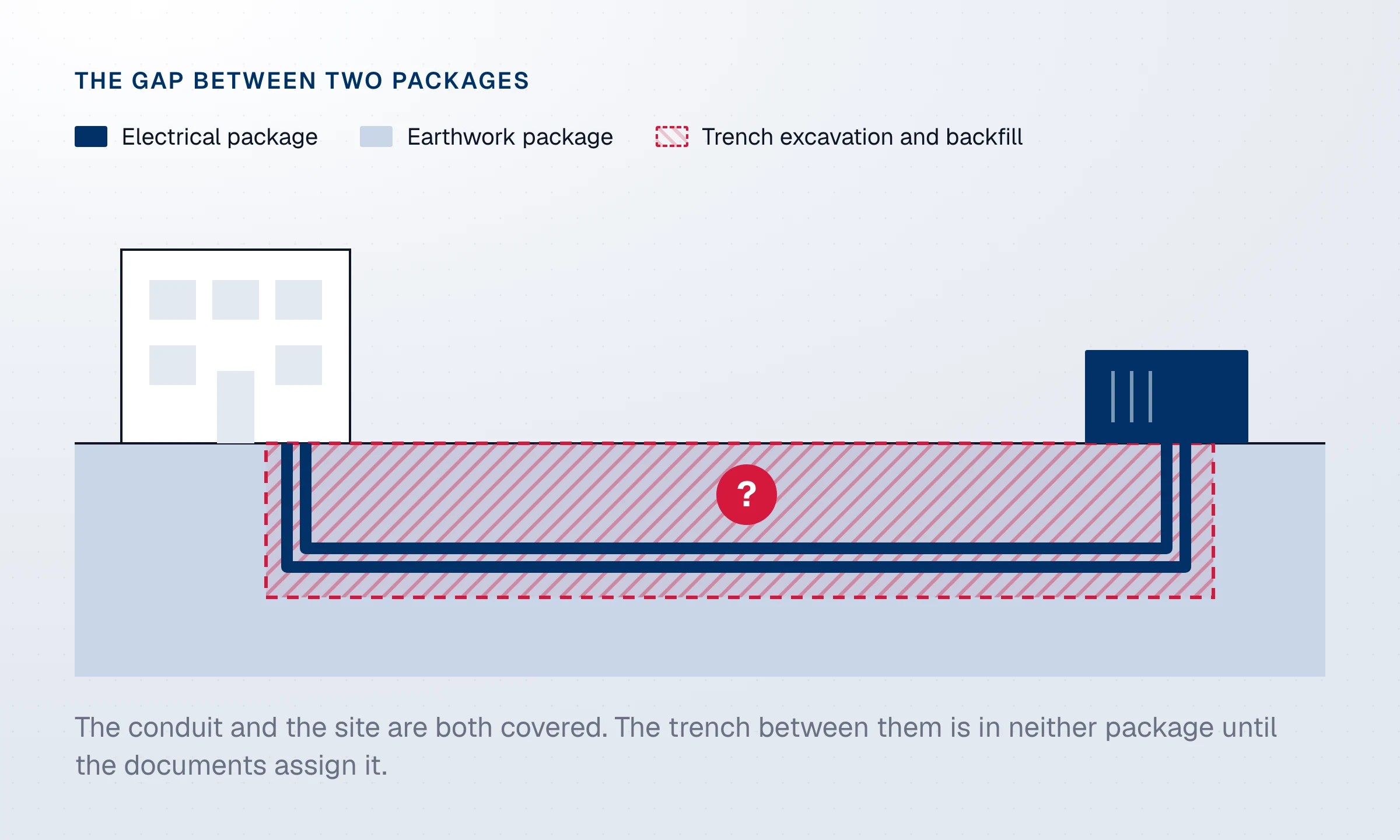
Massachusetts: the subcontractor paid. In AMP Electrical v. W.M. Schultz Construction, the electrical subcontractor on a municipal pumping station refused responsibility for trench excavation and backfill for underground conduit. Addendum No. 2 had answered a pre-bid question by assigning that work to the electrical bidder, and Addendum No. 3 replaced an electrical sheet with the trench details. The subcontract included both addenda.
The subcontractor did the work under protest, claimed extra compensation and lost on appeal. The court said the confusion should have been resolved by asking for clarification before bidding.
Québec: the general contractor paid. In Groupe Promec v. Ali Excavation (Superior Court, 2026), electrical work at Montréal's airport was bid through the BSDQ, Québec's bid depository for specialty trades. One electrical bidder excluded excavation, backfill and concrete bases, though the specification placed that work in the electrical section. The general contractor kept the cheaper bid.
The court found the exclusion non-conforming and ordered the general contractor to compensate the lowest conforming bidder for its lost profit. As Miller Thomson summarizes it, the general contractor is responsible for checking that the bids it receives conform, and must not simply take the lowest price.
Read together, the two cases say the same thing. What decides who pays is what the documents say about the work, and whether someone checked them before signing.
How bids reveal and hide gaps
A proposal can exclude an item in plain words, which is visible, or leave it unpriced without mention, which is not. The back pages of a proposal, titled qualifications, clarifications or exclusions, deserve a read before the pricing page. A line such as "per plans and specifications" confirms nothing, since it hands the scope decision back to the general contractor.
The Québec case adds a rule worth applying anywhere: an exclusion is judged against the wording of the specification, and trade custom does not rescue it. Check every exclusion against the section that assigns the work before accepting the bid.
A check before subcontracts are signed
- Assign every specification section, drawing discipline and general requirement to a trade package.
- List the interfaces between packages (pads, sleeves, penetrations, connections, patching, temporary services) and who furnishes, installs and connects each.
- Check each addendum against the packages: what it moved, added or reassigned.
- Mark each proposal line as included, excluded or unclear. Check each exclusion against the section that assigns the work, and clarify the unclear ones in writing.
- Write the decisions into the subcontract scope exhibit, with specific drawing, specification and addendum references.
Keep the subcontract specific
Vertex, an engineering consultancy, advises against attaching the subcontractor's proposal as an exhibit. It recommends binding the subcontractor to specific sections of the construction documents and prime contract instead. A proposal carries its own exclusions, and a subcontract that references it inherits them.
The Massachusetts case shows the payoff: a subcontract that names the sections and addenda it covers leaves little room to argue later.
Where Telamont fits
Comparing every package against every document, addenda included, is the step that gets cut when a bid window is short. Telamont is a platform that reads plans, specifications, addenda and contracts together and flags conflicts, errors and omissions across them. The team sees work that appears in one document and not in another, or that an addendum moved, before packages go out.
The decisions stay with the estimator and the project manager, who know the project and decide what each finding means for their packages. Risk detection shows how the findings are produced.
This article is general information. For a specific project, check the signed contract and the law that governs it.
FAQ
What is a scope gap in construction?
A scope gap is work the project requires that no subcontractor's scope includes. It usually comes from an interface between trades, a difference between documents, an addendum, or an exclusion nobody leveled back in.
Who pays for a scope gap?
The documents decide. In AMP Electrical v. W.M. Schultz, the addenda assigned the work and the subcontractor carried it. In Groupe Promec v. Ali Excavation, the general contractor accepted a bid that excluded required work and paid for it. Where the documents are silent, ASCE notes the general contractor is the party likely to carry the ambiguity.
What is the difference between an exclusion and a scope gap?
An exclusion is stated in the proposal, so it can be seen and checked. A scope gap is an item the subcontractor did not price and did not mention, so the proposal gives no signal that it is missing.
When should a general contractor look for scope gaps?
While building the trade packages, after each addendum, while leveling the returned bids, and before the subcontracts are signed.
Does bid leveling find every scope gap?
Leveling compares proposals against a baseline, so it finds what the baseline includes. If the baseline itself misses an item that sits between two documents, every bidder will omit it the same way, and the comparison will look clean.
Can software help find scope gaps?
A dedicated construction platform can read the full document set, addenda included, and surface items that appear in one document and not in another. The team still decides how each item is assigned to a trade.
Sources
See Telamont on a project like yours
In 30 minutes, we walk you through a project similar to yours: the risks Telamont finds, the clause behind each one, and the notice it drafts for your team.