

The Complete Guide to Claim Deadline Tracking (2026)

How to build a notice of claim deadline tracking process for construction contracts, with the notice windows in AIA, FIDIC, ConsensusDocs and FAR forms.

A missed notice deadline can wipe out a claim, whatever its merits. Under AIA A201-2017, a contractor has 21 days from an event to initiate a formal claim. Under FIDIC 2017, the window is 28 days. Miss either, and the entitlement can be gone.
Claim deadline tracking is the discipline that keeps those rights alive. This guide covers the types of deadlines to monitor, the contract forms that impose them, and the register and habits that keep them from slipping.
Key Takeaways: Claim Deadline Tracking
- A late notice of claim can waive the entitlement entirely, even when the underlying claim has full merit and documentation.
- AIA, FIDIC, ConsensusDocs, and FAR contracts each impose different notice windows, triggers, and service requirements.
- A notices register built from the signed contract, with one owner per deadline, is the most reliable tool for tracking them.
- Telamont flags notice periods too short to comply with, lists every notice obligation in your contracts with its deadline and page, and drafts the notice when an event happens.
What Is a Notice of Claim Deadline?
A notice of claim deadline is a contractual time limit within which one party must formally notify the other of an event or condition that may give rise to a claim for additional time or money. The notice preserves the right to make the claim; the claim itself follows.
Some forms, like FIDIC, make timely notice an express condition precedent, and many courts enforce other forms' notice clauses just as strictly: if the notice arrives late, the right to recover can be extinguished before anyone examines the facts. In a 2025 legal brief for ASCE, construction lawyers Michael Loulakis and Ashley Cullinan note that claimants lose supported claims for several reasons, the most common being a failure to give the other party proper notice.
Why Claim Deadline Tracking Matters for Construction Contract Administration
A single prime contract can contain notice requirements for delay claims, differing site conditions, change orders, defective work, and force majeure events, each with its own deadline, trigger, and consequence. Subcontracts flow those obligations down, often with shorter windows.
A deadline caught at the start of a project is an item on a register. The same deadline missed six months later is a waived claim. What separates the two outcomes is a tracking process.
Types of Notice Deadlines in Construction Contracts
Notice deadlines work in different ways, and the type sets the consequence of missing one.
Condition Precedent Deadlines
A condition precedent clause makes timely notice a prerequisite to the entitlement. Miss the window, and the right to additional time or money can be lost. FIDIC 2017 Sub-Clause 20.2.1 is the most explicit example.
Cost Cut-Off Deadlines
Federal contracts under the FAR use a different mechanism. FAR 52.243-4(d) and 52.242-14(c) bar recovery of costs incurred more than 20 days before the written notice. A late notice shrinks the recoverable amount while the entitlement survives.
Procedural Notice Deadlines
Some notice clauses impose a deadline without stating a consequence. Missing one weakens the position and, in some courts, waives the claim. The safest approach is to treat every notice deadline as if the consequence were waiver.
Final-Payment Backstops
FAR 52.243-4(f), 52.242-14(c), and 52.236-2(d) bar claims or adjustment requests made after final payment, independently of every other deadline. Track the projected final-payment date alongside the rest.
Notice Requirements Across Major Contract Forms
The deadline you need to hit depends on the contract form governing your project. Here are the most common forms in North American construction.
AIA A201-2017
Claims must be initiated within 21 days after the event or after first recognizing the condition, whichever is later. Notice of concealed or unknown conditions has a shorter window: promptly, before the conditions are disturbed, and no later than 14 days after first observing them (§3.7.4).
A notice of claim must be delivered by certified or registered mail, or by courier. Email works for other notices only when the agreement sets it up, so an email that satisfies everything else may still fail to serve a claim.
FIDIC 2017 (Red Book)
A Notice of Claim is due no later than 28 days after the claiming party became aware, or should have become aware, of the event. If it is late, the claiming party is not entitled to its claim, and the time bar now applies to both contractor and employer. If the Engineer does not object within 14 days, the notice is deemed valid, though the other party can still dispute it, and the Engineer may excuse a late notice under Sub-Clause 20.2.5. A second bar follows: a fully detailed claim, with its legal basis, is due within 84 days, or the notice lapses.
ConsensusDocs 200
Written notice of a claim is due within 14 days of the event or of first recognizing the condition, whichever is later, and before proceeding with the work except in an emergency. Supporting documentation follows within 21 days, and the owner must answer in writing within 14 days. Delays carry their own notice provisions (§6.3 and §6.4).
FAR (Federal Contracts)
To have a delay excused under the Default clause, the contractor must notify the Contracting Officer in writing of its causes within 10 days from the beginning of the delay, unless the Contracting Officer extends it (52.249-10(b)(2)). Under the Changes clause, the contractor must assert its right to an adjustment within 30 days of a written change order or of its own notice (52.243-4(e)). The 20-day cost cut-offs, with exceptions for defective specifications and suspension orders, and the final-payment bars apply on top.
How to Build a Notices Register for Deadline Tracking
The notices register is a single document that captures every notice obligation, event, awareness date, deadline, notice sent, and response, with deadlines calculated from the signed contract. Building it takes four steps.
- Extract every notice obligation. Read the prime contract, every subcontract, the general and supplementary conditions, and any riders. A single A201 contract has notice requirements in its claims, concealed conditions, changes, delays, insurance, and termination provisions.
- Record the trigger, the deadline, the service method, and the consequence. Some deadlines run from the event, some from awareness; AIA and ConsensusDocs run from the later of the two. Each line links to the clause it comes from.
- Assign one owner per deadline and review the register weekly with the site team. Flag items within 10 days of their deadline in amber and within 5 business days in red, to leave time for drafting, sign-off, and courier delivery.
- Link each notice to the claim or change order it supports, with the date sent, the proof of delivery, and the response deadline. The register then doubles as a claims log.
Extraction is where most registers fail. A rider that shortens the window from 21 days to 7, a supplementary condition that overrides the general conditions, or a flow-down provision the subcontractor never negotiated surfaces as a waived claim months later.
Common Deadline Tracking Failures and How to Avoid Them
Most missed deadlines come from gaps in the process. These come up again and again.
Relying on Memory Instead of a Register
A project manager who "knows" the notice periods is one vacation, one reassignment, or one new project away from missing a deadline. Track each deadline in writing, linked to the clause, with a named owner.
Calculating Deadlines from the Wrong Trigger
The gap between "from the event" and "from awareness of the event" can be days or weeks. A register built on the wrong trigger date creates false confidence.
Sending Notice by the Wrong Method
Under A201-2017, an email that satisfies every other notice clause may still fail to serve a claim. Check the service method required by the specific clause as well as the general notice provision.
Treating Subcontract Deadlines as Identical to Prime Contract Deadlines
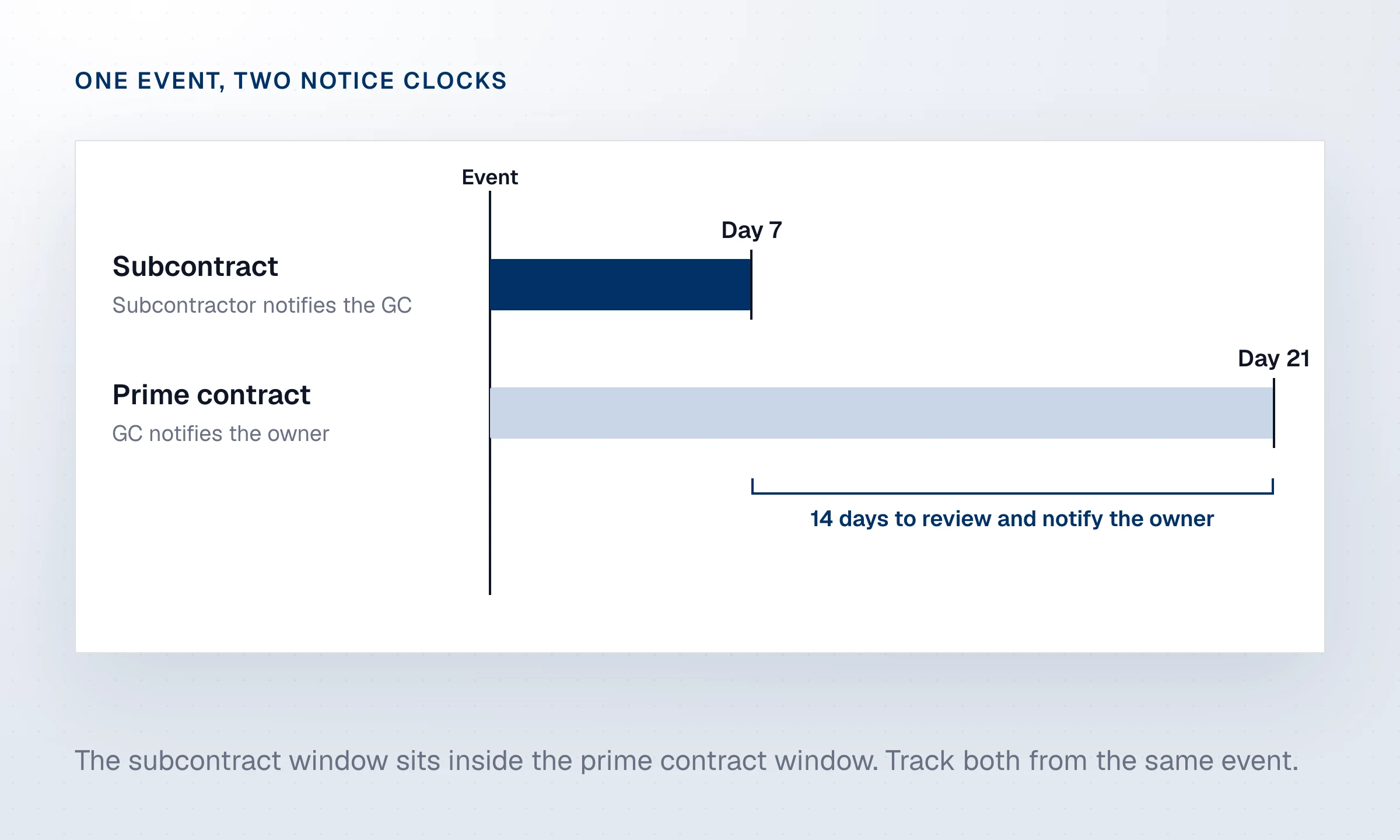
A general contractor with 21 days to notify the owner may have given the subcontractor only 7 or 10 days. Read the subcontract and the prime contract together, and track both windows so the subcontractor's notice reaches the general contractor in time to notify the owner.
Waiting for Certainty Before Notifying
Contractors hesitate to send a notice when they are unsure whether an event qualifies as a claim, and that hesitation runs down the clock.
A precautionary notice, worded factually, costs far less than a lost claim.
How to Draft a Notice That Meets Contractual Requirements
A notice that arrives on time but misses the contract's content requirements can be disputed as deficient. At a minimum, it states:
- The date the event occurred or the date you first identified it.
- A description of the event, tied to specific facts.
- The contract clause that requires the notice and grants the entitlement.
- The estimated impact on the schedule, the cost, or both.
- The mitigation steps you are taking.
Telamont's notice drafting builds these in. Start from a risk Telamont found or from a blank notice: it carries over the contract and the clause, writes the notice from the project documents with every statement cited to its source, and fills your own template if you have one. Before you send, it scores the notice out of 100 and lists what to fix first, from the impacts and the contract citation to the facts, the demand, and the tone.
Serve it by the method the contract specifies, send it to every recipient the contract names (the owner and the architect under AIA forms, the Engineer under FIDIC), and keep proof of delivery. A notice without proof of delivery is a notice the other party can deny receiving.
What Happens When a Deadline Is Missed
A missed deadline sometimes leaves room to argue. Some jurisdictions ask whether the other party was actually prejudiced by the late notice, and a party that engaged with a claim on its merits may have waived the time bar. Both arguments depend on the jurisdiction and the other side's conduct, so neither is a plan.
Many courts and arbitrators enforce notice clauses strictly. In Electri-Tech v. Radnor Township, a Pennsylvania case under AIA A201-2007, the contractor's $151,000 delay claim failed for lack of timely notice, and the owner lost its $107,250 liquidated damages claim for missing the 21-day claim notice. The contractor recovered only its $27,850 final payment, less than it spent on legal and expert fees.
Assigning Ownership of the Notice Function
On many projects the project manager owns everything, including notices, and the notice is the task that slips when the schedule is under pressure. The clock often starts when the site team recognizes the condition, so the site has to be part of the process.
The superintendent or project manager logs every potential event the day it is spotted. A named person in contracts, operations, or project controls owns the register, reviews it weekly, and issues the notice.
Where Telamont Fits
Telamont reads the prime contract, subcontracts, specifications, and drawings together. Its risk detection flags notice periods too short to comply with, obligations passed down to a subcontract without their protections, and precedence rules that let a shorter window win. A shared board lists every notice obligation in your contracts with its event, deadline, and page.
When an event happens, Telamont drafts the notice from the clause that requires it and scores it before you send. The risk then moves to an operations board, where it is assigned to an owner, tracked, and closed with its history intact.
In Conclusion: Building a Defensible Deadline Tracking Process
Build the register from the signed contract. Calculate every deadline from the correct trigger. Assign an owner to every obligation. Review weekly. Notify early. A claim with a complete record and a timely notice gets argued on its merits.
Download the 15 conflicts guide to see the contradictions Telamont catches across specs, drawings, and contracts.
This guide is general information. For the deadlines on a specific project, check the signed contract and the law that governs it.
FAQs About Claim Deadline Tracking
What is claim deadline tracking in construction?
Claim deadline tracking is the process of identifying, recording, and monitoring every contractual notice obligation on a project so that notices go out before their deadlines expire. It covers delay claims, differing site conditions, change orders, and force majeure events. A register linked to the signed contract clauses is the standard tool.
What happens if a contractor misses a notice deadline?
The consequence depends on the contract. Under condition-precedent clauses like FIDIC Sub-Clause 20.2.1, the claiming party can lose its entitlement. Under FAR 52.243-4(d), costs incurred more than 20 days before the notice are not recoverable.
How does Telamont help with notice deadline tracking?
Telamont reads your contracts, subcontracts, specifications, and drawings together, flags notice periods too short to comply with, and lists every notice obligation with its deadline and page on a board your team shares. When an event happens, it drafts the notice from the clause that requires it, and the risk moves to an operations board where it is assigned, tracked, and closed.
How many days do contractors have to file a notice of claim?
The window varies by contract form. AIA A201-2017 allows 21 days from the event or first recognition, whichever is later. FIDIC 2017 allows 28 days from when the party became aware, or should have become aware, of the event. ConsensusDocs 200 requires written notice within 14 days. Federal contracts under the FAR impose a 10-day delay notice, a 30-day deadline to assert a change adjustment, and 20-day cost cut-offs, with exceptions.
Can a missed notice deadline be excused?
In some jurisdictions, yes, if the other party was not prejudiced by the late notice or waived the right to enforce the time bar. Many courts and arbitrators still enforce clearly drafted notice clauses strictly, so treat every deadline as firm.
What is the difference between a notice of delay and a notice of claim?
A notice of delay tells the other party that a delay has occurred. A notice of claim is a formal request for additional time, money, or both. ConsensusDocs 200 handles the two in separate provisions, and sending the delay notice may not satisfy the claim requirement, so track both.
Sources
- Think you have a contractual claim? Speak up before it slips away, Michael C. Loulakis and Ashley P. Cullinan, ASCE Civil Engineering Source, 2025
- Notice Requirements Under the Revised A201 2017 AIA Document Series, Amundsen Davis, 2017
- It's easy when you know how: claims under FIDIC 2017, Paul Battrick, ICC, 2020
- Snooze you lose: enforcement of notice and timing provisions, Cornelius F. Banta Jr., ConsensusDocs, 2024
- FAR 52.243-4 Changes, FAR 52.242-14 Suspension of Work, FAR 52.236-2 Differing Site Conditions, FAR 52.249-10 Default, acquisition.gov
See Telamont on a project like yours
In 30 minutes, we walk you through a project similar to yours: the risks Telamont finds, the clause behind each one, and the notice it drafts for your team.