

Conflicts between drawings and specifications: which one wins, and how to catch them before construction

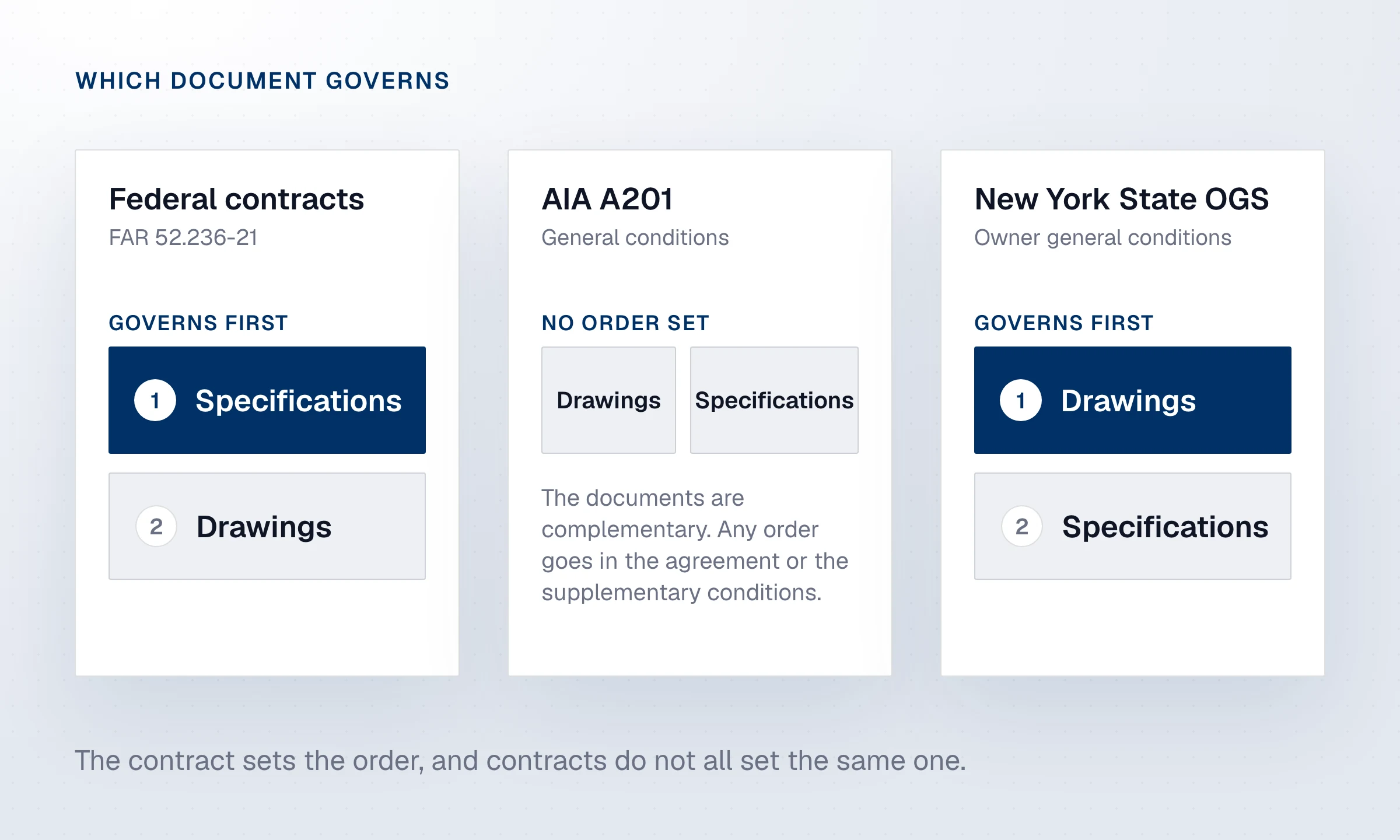
When drawings and specifications conflict, the contract’s order-of-precedence clause decides which one governs: federal contracts and ConsensusDocs 200 favor the specifications, AIA A201 sets no order of its own, and some owners put the drawings first.
A building is described twice. The drawings show where everything goes and how it fits together. The specifications say what it is made of, how it is installed and how it is tested.
When the two disagree, two questions matter: which document governs, and how to find the disagreements while they are still cheap to settle.
The short answer: a conflict between drawings and specifications is resolved by the contract's order-of-precedence clause. Federal construction contracts that include FAR 52.236-21 (a clause from the Federal Acquisition Regulation) and the ConsensusDocs 200 agreement (a standard contract developed by construction industry organizations) let the specifications govern over the drawings.
The AIA A201 general conditions, the American Institute of Architects' standard contract terms, treat the documents as complementary and leave any order of precedence to the agreement or the supplementary conditions. Some public owners put the drawings first. The reliable answer is always in your own contract.
Which governs when drawings and specifications conflict?
On federal work, contracting officers insert FAR 52.236-21 in fixed-price construction contracts, and it is direct: "In case of difference between drawings and specifications, the specifications shall govern."
The same clause says that anything shown on the drawings and not mentioned in the specifications, or the reverse, applies as if it appeared in both. A discrepancy in figures goes to the Contracting Officer for a written determination, and any adjustment the contractor makes without one is "at its own risk and expense."
ConsensusDocs is a family of standard contracts developed since 2007 by a coalition of industry organizations that includes the Associated General Contractors of America. Its 200 document, the agreement and general conditions between owner and contractor, also says the specifications govern over the drawings, a provision the Construction Specifications Institute quotes as Section 14.2.2. A Florida construction law blog reproduces the full order of precedence that follows:
- Change orders and written amendments to the agreement
- The agreement itself
- The drawings (large scale governing over small scale), specifications and addenda
- Information furnished by the owner
- Other documents listed in the agreement
Within the same category, the provision with the latest date controls. Information that appears in one document and not in another is not treated as a conflict.
AIA A201, the General Conditions of the Contract for Construction published by the American Institute of Architects, takes another route. Section 1.2.1 states that "the Contract Documents are complementary, and what is required by one shall be as binding as if required by all." A201 sets no order of priority of its own. When an owner wants one, it goes in the agreement or the supplementary conditions.
Can an owner set a different order of precedence?
Owners can write their own precedence clause into the contract. The University of Wisconsin System's edition of A201-2017 ranks addenda over specifications, specifications over drawings, stated dimensions over scaled dimensions, large-scale details over small-scale drawings, and schedules over other data on the plans. It adds that where documents conflict, "the more stringent or better quality requirement, in the Owner's sole discretion, shall be controlling without any increase in the Contract Time or Contract Sum."
The New York State Office of General Services goes the other way: its general conditions say that "the drawings will take precedence over the specifications." Two public owners give opposite answers, which is why the clause deserves a careful read at the bid stage, before anyone relies on it during construction.
A precedence clause settles a conflict once someone has found it. Finding it is the job.
What happens when the contract is silent?
If no clause settles the question, courts fall back on rules of interpretation. A summary by the law firm Faegre Drinker lists the common ones: the more specific provision takes precedence over the general one, handwritten or marked-up changes carry more weight than pre-printed text, an unresolved ambiguity is read against the party that drafted the contract, and industry custom can decide the issue.
On federal work, an ambiguity "so glaring as to raise a duty to inquire" is patent, and a contractor who bids without asking may carry the cost. A subtle one is latent, and it is read against the drafter, provided the contractor's reading is reasonable.
A precedence clause can settle even a known discrepancy. In Hensel Phelps v. United States (1989), the specifications called for 18 inches of fill and the drawings for 36. The court held that the specifications governed and the contractor was entitled to an equitable adjustment.
What does the contract expect from the contractor?
General conditions can also require a document review. In the University of Wisconsin System's edition of AIA A201-2017, Section 3.2.2 asks the contractor to study and compare the documents before each portion of the work and to report the errors, inconsistencies or omissions it discovers as a request for information.
Section 3.2.4 works both ways: a contractor that performs the review is not liable for those errors unless it recognized one and failed to report it, and one that skips the review pays the costs it would have avoided.
Underneath these clauses sits United States v. Spearin (1918): when a contractor is bound to build according to plans and specifications prepared by the owner, "the contractor will not be responsible for the consequences of defects in the plans and specifications." Courts still apply it to design-bid-build work. On design-build projects, where the contract makes the design the contractor's responsibility, that risk shifts away from the owner.
What are the most common conflicts between plans and specifications?
The examples below show the forms these conflicts can take. Dimensions and quantities can drift apart: a plan dimension can stop matching its detail after a revision, the fixture count on the plumbing plan can differ from the fixture schedule, or a slab thickness can change between the structural notes and Division 03.
Materials, ratings and finishes can disagree too. The door schedule might list a 60-minute door in a wall the life safety plan shows as a 2-hour fire barrier. The finish schedule might call for sealed concrete in a room the specification lists for resilient flooring, or the roofing section might specify one insulation value while the roof detail shows another.
Scope can end up assigned twice, or to nobody. Firestopping at electrical penetrations might appear in both Division 07 and Division 26, or in neither, and equipment pads might be shown on the mechanical drawings but missing from the concrete scope. Gaps like these can carry into the subcontracts.
References can lead nowhere. A specification section might call for installation "as shown on Detail 7/A-501" when the set has no such detail, or when the detail sits on a sheet that was renumbered.
Changes can reach one document and miss the other. During bidding, an addendum can revise a specification section without reissuing the drawing it affects. After award, revisions, bulletins and RFI answers can do the same, so each one has to land in every document it touches.
What does a conflict cost when it is found late?
A conflict found in the field can lead to an RFI, a stop in the work, a change order or a claim. Once the answer changes cost or time, the contract's claim provisions apply, and their notice periods are short: the University of Wisconsin System's edition of A201 requires the contractor to initiate a claim within 21 days.
HKA's 2023 CRUX Insight report, built on more than 1,800 projects, ranks incorrect, late or incomplete design information among the top five causes of claims and disputes. In its US data, 35.7% of projects had one or more of those design failures, and sums in dispute across US projects averaged 34.4% of capital expenditure. The data set is weighted toward large capital projects.
On design errors, a study by Lopez and Love in the ASCE Journal of Construction Engineering and Management put practitioners' estimates of design error costs at 6.85% of contract value in direct costs and 7.36% in indirect costs, across 139 projects. Older RFI data points the same way: a 2013 Navigant Construction Forum study, mostly of Australian and New Zealand projects, estimated $1,080 to review and answer each RFI.
How do contractors catch conflicts before construction?
A conflict review fits two moments. During bidding, questions can still go to the design team before prices are fixed. After award and before mobilization, the team turns the documents into subcontracts, submittals and a schedule, and every conflict found then can be settled on paper before it reaches the field. The steps are the same at both moments.
- Start with the contract: find the order-of-precedence clause, the supplementary conditions that modify it and any "more stringent requirement governs" language. Everything else is read through that clause.
- Follow one system at a time: take doors, fire-rated assemblies, roofing or plumbing fixtures and trace each through the schedule, the plans, the details and the specification section. Conflicts can show up where a system crosses from one document to another.
- Check every cross-reference: each detail a specification cites should exist, and each specification section a drawing note cites should be in the project manual.
- Map scope by trade: build a scope matrix from the divisions and the drawings and compare it with each bid package, so every item belongs to exactly one subcontract.
- Log and send questions early: record each conflict with both sources, send it as a pre-bid question or an RFI and track the answer into every document it changes.
A conflict can also surface after the deadline for pre-bid questions. A bidder can then price the more demanding reading, or state its interpretation in the bid's clarifications where the instructions allow it. On public bids, read the instructions first: in a 1993 decision, the GAO rejected as nonresponsive a sealed bid that came with a "qualifications and exclusions" sheet.
What makes this review demanding is volume and timing. Every check compares one document with another, so each document added to the set multiplies the comparisons.
And the set keeps moving. During bidding, each addendum has to be checked against every drawing and section it touches. After award, so does each revision, bulletin and RFI answer. A team can review a set thoroughly once. Repeating that review every time a document changes, on every project at once, is the part that does not scale by hand.
Some public owners build this into their own process. The Florida Department of Transportation runs a biddability review on plans and specifications before letting, and its manual states that "conflicts and ambiguities between or among these elements must be resolved."
The US Army Corps of Engineers uses a biddability, constructability, operability and environmental (BCOE) review. A peer-reviewed study of 20 Corps projects found that a BCOE review significantly increased the likelihood of a complete and adequately constructed project.
Software helps exactly where the volume grows. Document management tools make it faster to search a set and compare revisions. A dedicated construction AI goes further and reads the documents against each other.
When you compare tools, look for one that reads the contract, specifications and drawings together, cites the page behind each finding and keeps up as revisions arrive. Our guide to choosing AI software for construction risk covers the criteria, and our comparison of dedicated construction AI and general-purpose assistants explains why a chat tool answers a different question.
How Telamont helps
Telamont runs this cross-check across the whole project. It reads the contract, the specifications and the drawings together, applies the order of precedence written in that contract, and flags each contradiction with the clause, specification section or drawing sheet behind it. When an addendum or a revision arrives, it checks the new version against the rest of the set. Contractors we work with find 55 to 160 risks per project before construction starts.
Your team keeps the decisions: which conflicts to raise, with whom and when, with the sources already in hand. See how Telamont works for general contractors.
This article is general information, not legal advice. For a specific conflict, check the signed contract, its supplementary conditions and the law that applies to the project.
FAQ
When drawings and specifications conflict, which one governs?
The contract's order-of-precedence clause decides. Federal contracts under FAR 52.236-21 and the ConsensusDocs 200 agreement let the specifications govern, while some owners, such as New York State's Office of General Services, put the drawings first.
What is an order-of-precedence clause?
It is a contract provision that ranks the contract documents, so that when two of them disagree, the higher-ranked one controls. It can sit in the agreement, the general conditions or the supplementary conditions.
Does AIA A201 say specifications govern over drawings?
No. A201 treats the contract documents as complementary and sets no order of priority of its own. Owners who want one add it to the agreement or the supplementary conditions, so check those documents on each AIA project.
Should a contractor send an RFI for every conflict between drawings and specifications?
Yes, for every conflict that affects cost, time or scope, and as soon as it is found. AIA A201 asks the contractor to report the inconsistencies it discovers as a request for information, and FAR 52.236-21 puts any adjustment made without a written determination at the contractor's own risk.
Is a conflict between plans and specifications handled the same way?
Yes. Plans and drawings are the same set of documents, so the same order-of-precedence clause applies, and the same rules of interpretation fill the gap when the contract is silent.
What is the usual order of precedence for construction documents?
There is no single standard. ConsensusDocs 200 ranks change orders and amendments first, then the agreement, then the drawings, specifications and addenda, with the specifications governing over the drawings. Owner clauses can add finer rules, such as stated dimensions over scaled ones and large-scale details over small-scale drawings.
How can a general contractor reduce RFIs caused by document conflicts?
Move the cross-checking earlier. A system-by-system review during bidding, sent as pre-bid questions, can settle conflicts before award, and a second review before mobilization catches what revisions changed.
Sources
- U.S. General Services Administration, FAR 52.236-21, Specifications and Drawings for Construction
- Acquisition.gov, FAR 36.521, Specifications and drawings for construction
- Florida Construction Legal Updates, Construction Contracts and Your "Order of Precedence" Clause (AIA A201, ConsensusDocs 200 as of that post and Hensel Phelps v. United States)
- University of Wisconsin System, AIA A201-2017 General Conditions, as modified
- New York State Office of General Services, Design Procedures Manual, Chapter 5.1 (quotes the OGS general conditions; check the edition in your contract)
- Legal Information Institute, United States v. Spearin, 248 U.S. 132 (1918)
- Construction Executive, P3s, Design-Build Models and the Spearin Doctrine: A Shift in Design Risk, 2017
- U.S. Government Accountability Office, Lathan Construction Corporation, B-250487, 1993
- ConsensusDocs, About ConsensusDocs
- Construction Specifications Institute, Beware: Know Your Order of Precedence, 2020
- Faegre Drinker, 8 Rules for Resolving Contract Confusion, 2008
- Cohen Seglias, Metric Constructors, Inc. v. NASA (patent and latent ambiguity)
- HKA, CRUX Insight 2023: Forewarned is Forearmed
- Navigant Construction Forum, Impact & Control of RFIs on Construction Projects, 2013
- Lopez and Love, Design Error Costs in Construction Projects, ASCE Journal of Construction Engineering and Management 138(5)
- Florida Department of Transportation, Construction Project Administration Manual, Chapter 1
- Ogburn and El-adaway, Biddability, Constructability, Operability, and Environmental Checklist, ASCE Journal of Legal Affairs and Dispute Resolution, 2014
See Telamont on a project like yours
In 30 minutes, we walk you through a project similar to yours: the risks Telamont finds, the clause behind each one, and the notice it drafts for your team.